
Certificate of Origin vs Certificate of Free Sale
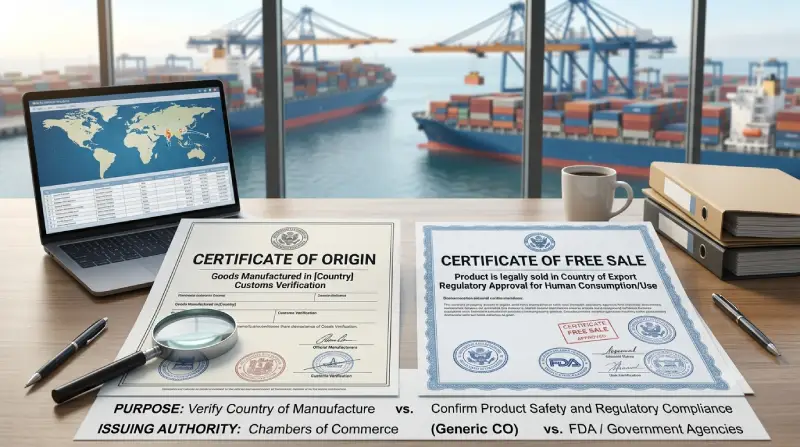
If you are preparing to ship goods to an international buyer, you will almost certainly encounter two documents that sound similar but serve very different purposes: the certificate of origin and the certificate of free sale. Understanding the difference between a certificate of origin and a certificate of free sale is critical for any exporter because submitting the wrong document or missing one entirely can stall your shipment at customs, trigger fines, or even lead to your goods being rejected at the border.
This guide breaks down what each document is, when you need one or both, who issues them, and the specific steps to obtain each. Whether you are a first-time exporter based in Northern California or a seasoned international seller expanding into new markets, this post will give you the clarity you need to keep your shipments moving.
What Is a Certificate of Origin?
A certificate of origin (COO) is an official trade document that identifies the country where the goods in a particular export shipment were manufactured or produced. Customs authorities in the importing country use this document to determine the correct duty rate, verify compliance with trade agreements, and decide whether the goods are admissible.
A certificate of origin answers one central question: where were these goods made? That single piece of information affects how much the importer pays in tariffs, whether the shipment qualifies for reduced duties under a free trade agreement, and in some cases, whether the goods can enter the country at all.
Types of Certificates of Origin
There are two main categories. A non-preferential (generic) certificate of origin simply states where the goods were produced without claiming any special tariff treatment. This is the standard document required by most importing countries and must typically be certified by a chamber of commerce.
A preferential certificate of origin (also called an FTA certificate of origin) goes a step further. It certifies that the goods qualify for reduced or zero tariffs under a specific free trade agreement, such as the United States-Mexico-Canada Agreement (USMCA). Preferential certificates are usually self-certified by the exporter, importer, or producer and do not always require a chamber stamp.
Who Issues a Certificate of Origin?
For non-preferential certificates, chambers of commerce have served as the official certifying bodies since the 1923 Geneva Convention. In the United States, exporters can submit applications through local chambers or through electronic certificate of origin (eCO) portals that issue chamber-stamped documents online, often within a single business day.
For preferential FTA certificates, the certifying party depends on the agreement. Under USMCA, for example, the exporter, producer, or importer can self-certify by including nine required data elements on the certification document. No chamber stamp is needed.
What Is a Certificate of Free Sale?
A certificate of free sale (CFS) is an official document that certifies a product is legally manufactured, marketed, and freely sold in its country of origin without restriction. Unlike a certificate of origin, which focuses on where goods were made, a certificate of free sale focuses on whether the product meets domestic regulatory standards and is approved for commercial distribution.
Foreign governments request this document to confirm that the product being imported has already passed the safety, quality, and labeling requirements of the exporting country. In the United States, a certificate of free sale is sometimes called a “Certificate for Export” or a “Certificate to Foreign Governments.”
Which Products Require a Certificate of Free Sale?
Certificates of free sale are most commonly required for products regulated by the U.S. Food and Drug Administration (FDA). These include food and beverage products, dietary supplements, cosmetics and personal care items, medical devices, pharmaceutical products, and biologics. If your product falls into any of these categories and your buyer or the importing country asks for proof that it is legally sold in the U.S., a certificate of free sale is the document you need.
Agricultural products may also require equivalent certificates issued by state departments of agriculture or the USDA, depending on the product type and destination country.
Who Issues a Certificate of Free Sale?
The issuing authority depends on the product. For FDA-regulated goods, the FDA itself can issue certificates of free sale through its online export certificate application system. For non-FDA products, authorized chambers of commerce can issue a certificate of free sale based on an affidavit from the exporting company, along with invoices proving recent U.S. sales. State agencies also issue certificates of free sale for products they regulate. In California, for instance, the California Department of Food and Agriculture can issue certificates for certain food and agricultural products.
Key Differences Between a Certificate of Origin and a Certificate of Free Sale
The simplest way to understand the difference between a COO vs. CFS is to remember that a certificate of origin answers “where was this made?” while a certificate of free sale answers “is this product legally and safely sold in the exporting country?”
| Feature | Certificate of Origin (COO) | Certificate of Free Sale (CFS) |
| Primary Purpose | Confirms the country where goods were manufactured or produced | Confirms the product is legally sold and meets regulatory standards in the exporting country |
| Used By | Customs authorities to determine tariffs and trade agreement eligibility | Regulatory and health authorities to approve product registration and import clearance |
| Product Focus | All types of exported goods | Primarily FDA-regulated products: food, cosmetics, supplements, medical devices, pharmaceuticals |
| Issued By | Chambers of commerce (generic COO) or self-certified (FTA COO) | FDA, authorized chambers of commerce, or state agencies |
| Tariff Impact | Directly affects import duty rates and FTA preferential treatment | No direct tariff impact; affects product registration and market access |
| Typical Cost | $25-$100+ depending on chamber and format | $75-$100+ for chamber-issued; FDA certificates vary by product type |
| Validity | Shipment-specific (generic) or up to 12 months (FTA blanket) | Varies by importing country; typically 6-12 months |
These two documents address entirely different concerns. A certificate of origin deals with trade logistics, tariffs, and country-of-manufacture verification. A certificate of free sale deals with product safety, regulatory compliance, and market access. Confusing one for the other, or assuming one can substitute for the other, is a common and costly mistake.
When Do You Need a Certificate of Origin?
You will need a cert of origin in several common situations. First, if the importing country requires one for customs clearance, which many countries do for all or certain categories of goods. Second, if your shipment qualifies for reduced tariffs under a free trade agreement, the USMCA certification of origin is the document that proves eligibility. Third, if the terms of your letter of credit specify a certificate of origin as part of the required documentation.
For Northern California exporters, USMCA certification is particularly relevant. California exported over $22 billion in goods to Canada and Mexico combined in 2023, and a USMCA certificate of origin can mean the difference between paying full duty rates and paying zero. If you are shipping manufactured goods, agricultural products, or technology components to either country, verifying whether your product qualifies under USMCA rules of origin is worth the effort.
Some countries, such as Kazakhstan and certain Middle Eastern nations, require a certificate of origin for every single import, regardless of product type. Your freight forwarder or customs broker can confirm whether the destination country has a blanket COO requirement.
When Do You Need a Certificate of Free Sale?
A certificate of free sale is typically required when you are exporting FDA-regulated products and the importing country, foreign buyer, or foreign regulatory authority requests proof that the product is legally sold in the United States. This is common when exporting to markets in the Middle East, Latin America, and Asia, where foreign health ministries require a certificate of free sale before they will register or approve a new product for import.
The requirement is product-driven, not country-driven. If you export unregulated industrial goods, you will likely never need a certificate of free sale. But if you export cosmetics, dietary supplements, food products, medical devices, or pharmaceuticals, you should expect to encounter this requirement regularly. Some importing countries also require that the certificate of free sale be notarized, apostilled, or legalized by their consulate before it will be accepted.
Do You Need Both Documents?
In many export transactions, the answer is yes. Consider a Northern California food manufacturer exporting organic snack products to South Korea. The Korean customs authority will require a certificate of origin to determine the applicable tariff rate and verify the country of manufacture. At the same time, the Korean Ministry of Food and Drug Safety will require a certificate of free sale to confirm the products are legally sold in the U.S. and comply with FDA regulations. Without both documents, the shipment could be held at the port.
The general rule: if your product is regulated (food, cosmetics, supplements, medical devices, pharma) and you are shipping to a country with strict import controls, plan on needing both a COO and a CFS. If your product is non-regulated (industrial components, raw materials, technology hardware), a certificate of origin alone is usually sufficient. Always confirm requirements with your buyer, freight forwarder, or the importing country’s customs authority before shipping.
How to Obtain Each Document
Getting a Certificate of Origin
For a generic (non-preferential) certificate of origin, the standard process involves preparing the certificate form, attaching a copy of the commercial invoice showing the country of origin for each item, and submitting both to a local chamber of commerce for certification. Many chambers now offer electronic submission through eCO portals, which can cut turnaround time to under 24 hours. The typical cost ranges from $25 to $100 per certificate, depending on the chamber and whether you need physical or electronic delivery.
For an FTA certificate of origin (such as USMCA), you do not need a chamber stamp. The exporter, producer, or importer completes the certification themselves, including the nine required data elements specified in the agreement. USMCA certifications can cover a single shipment or serve as a blanket certification valid for up to 12 months of identical shipments to the same consignee. Exporters should apply for a certificate up to three weeks before goods depart, though retrospective applications are possible up to three months after shipment.
Getting a Certificate of Free Sale
For FDA-regulated products, you can apply for a certificate of free sale directly through the FDA’s online export certificate application system. The specific certificate type depends on your product category: Certificate of Free Sale for food and cosmetics, Certificate to Foreign Government for drugs and medical devices, and Certificate of Exportability for products that cannot be legally marketed in the U.S. but meet export standards.
For non-FDA products or when you need a chamber-issued certificate of free sale, you can apply through authorized chambers of commerce. The typical process requires uploading two invoices showing recent U.S. sales of each product (dated within the last 12 months), company information, product descriptions, and the destination country. Chamber-issued certificates of free sale typically cost $75 to $100 each plus delivery fees. The turnaround is usually one to two business days.
Common Mistakes Exporters Make with Export Documents
Confusing the two documents: This is the most frequent error. An exporter provides a certificate of origin when the importing country actually requires a certificate of free sale, or vice versa. The names sound vaguely similar, but customs and regulatory authorities treat them as completely different documents. Submitting the wrong one does not satisfy the requirement.
Not verifying the importing country’s specific requirements: Requirements vary significantly from country to country and even product to product. Some countries require both documents, some require only one, and some have additional requirements like notarization, apostille, or consular legalization. Always confirm requirements before you ship, not after your goods are sitting in a foreign port.
Using expired or outdated certificates: Certificates of free sale typically need to reflect recent commercial activity, meaning invoices dated within the last 12 months. Certificates of origin should generally be applied for within three weeks of shipment. Using old documentation can result in rejection at customs or delays during product registration.
Assuming FTA certificates work the same as generic COOs: A USMCA certification of origin is self-certified and does not require a chamber stamp. A generic certificate of origin does. Applying the wrong process to the wrong certificate type creates problems on both ends of the transaction.
Frequently Asked Questions
Q: What is the difference between a certificate of origin and a certificate of free sale?
A certificate of origin confirms the country where goods were manufactured or produced and is used by customs authorities to assess tariffs. A certificate of free sale confirms that a product is legally marketed and freely sold in its country of origin and is used by foreign regulatory authorities to approve product imports. One deals with trade and tariffs; the other deals with product safety and regulatory compliance.
Q: Can a single document serve as both a certificate of origin and a certificate of free sale?
No. These are separate documents issued by different authorities for different purposes. A certificate of origin does not address product safety or regulatory status, and a certificate of free sale does not verify country of manufacture. If both are required for your shipment, you must obtain each one individually.
Q: How much does a certificate of free sale cost?
Costs vary by issuing authority. Chamber-issued certificates of free sale typically cost between $75 and $100 per certificate, plus delivery fees. FDA-issued export certificates have their own fee schedules that vary by product type. Budget for these costs as a standard part of your export compliance expenses.
Q: Do all exports require a certificate of origin?
Not all exports require a certificate of origin, but many importing countries do require one. Whether you need a COO depends on the destination country, the product, and whether you are claiming preferential tariff treatment under a free trade agreement. When in doubt, confirm requirements with your freight forwarder, customs broker, or the importing country’s customs authority.
Q: How long is a certificate of free sale valid?
Validity depends on the requirements of the importing country. Some countries accept certificates dated within the last six months, while others require them to be issued within 12 months of the shipment date. The invoices used to obtain the certificate must also be recent, typically within the last 12 months. Always verify validity requirements with the foreign buyer or regulatory authority before applying.
Your Trusted Guide for Export Documentation
Navigating the world of export documents can feel overwhelming, but you don’t have to go it alone. As a World Trade Center Northern California member, you have access to our experienced trade service partners who can guide you through every step of the process.
If you’re a food manufacturer looking to expand into South Korea or any other global market, our team can help you determine exactly which documents you need, from certificates of origin to certificates of free sale, and connect you with the right issuing authorities.
Take advantage of our export resources:
- Learn more about the benefits of World Trade Center Northern California membership
- Connect with our network of trusted trade service partners
- Discover how the California Capital Region Export Plan can help your business grow internationally
- Stay up-to-date on the latest export trends and regulations through our global connections and trade programs
- Register for an upcoming trade event to expand your knowledge and network
Don’t let confusion over export paperwork hold your business back. Contact us today to learn how we can help you open up a world of opportunity.