
What Is a Certificate of Free Sale and Why Do Exporters Need One?
If you export cosmetics, dietary supplements, food products, or medical devices, there’s a good chance your destination country will ask for a certificate of free sale before allowing your shipment through customs. Most exporters encounter this requirement for the first time mid-shipment, at the worst possible moment. This guide explains exactly what a certificate of free sale is, which products need one, who issues them in the United States, and how to obtain one quickly so your exports stay on schedule.
What a Certificate of Free Sale Actually Certifies
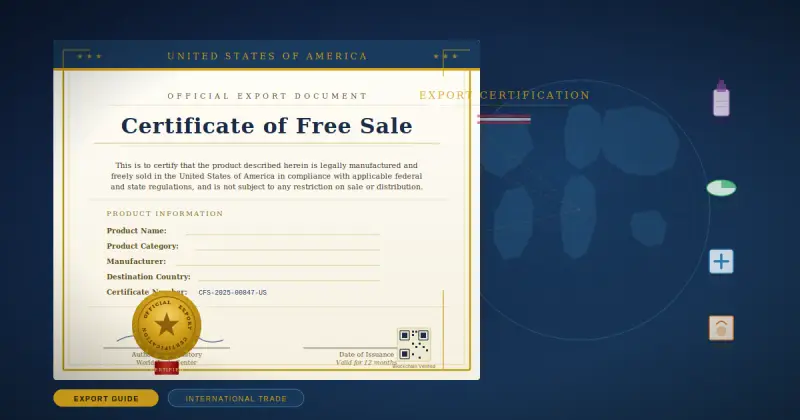
A certificate of free sale (CFS) is an official export document that certifies a product is legally manufactured and freely sold in its country of origin. In the United States, that means the product complies with applicable federal and state regulations and is commercially available to consumers without restriction.
The document does not guarantee product quality or safety in the way a lab test would. What it does guarantee is that no legal prohibition exists against selling the product in the US market. Importing countries use this assurance as a baseline compliance check before allowing the product into their distribution channels.
The term appears under several names in international trade: cert of free sale, certificate for export, certificate of free commerce, and sometimes certificate to foreign governments. Regardless of the name on the form, the underlying purpose is the same: telling the importing country’s authorities that the product is not banned, restricted, or recalled in the US.
Which Products Require a Certificate of Free Sale?
Not every export requires one, which is why many US companies go years without encountering this document. The requirement is concentrated in specific product categories that importing countries regulate at the point of entry:
Cosmetics and personal care products are the most common trigger. The European Union, China, South Korea, and most markets in Southeast Asia require CFS documentation before cosmetics can be registered or sold locally. Skincare, haircare, and beauty products typically cannot be distributed without it.
Dietary supplements and nutraceuticals face similar requirements across Latin America, the Middle East, and parts of Asia. Countries including Saudi Arabia, Brazil, and Indonesia require a valid CFS before health products can clear customs registration.
Food and beverage products destined for markets with strict import registration systems, including Japan, Mexico, and several Gulf Cooperation Council (GCC) countries, commonly require CFS documentation alongside other food safety certifications.
Medical devices often require both a CFS and a GMP certificate (Good Manufacturing Practice) for export to the European Union, the Middle East, and across much of Asia. The two documents work together: the CFS proves the product is sold in the US, and the GMP certificate confirms manufacturing standards.
The specific requirement depends on the destination country, the product category, and the importing country’s regulatory authority. When in doubt, confirming with a trade specialist before the shipment departs is far less costly than resolving a customs hold after the fact.
Who Issues a Certificate of Free Sale in the United States?
Unlike a passport or a tax document, there is no single federal agency that issues certificates of free sale for all product categories. The issuing authority depends on the product type:
FDA-Issued CFS Documents
The US Food and Drug Administration issues certificates of free sale for certain food products and cosmetics through its Certificate to Foreign Government program. FDA-issued certificates carry significant authority with foreign regulatory bodies, but the application process involves specific eligibility requirements and can take several weeks.
Chambers of Commerce
For most non-pharmaceutical products, US chambers of commerce are the standard issuing authority. Chambers recognized by the US government can certify that a product is legally sold in the United States and issue the document officially. World Trade Center Northern California, for example, issues certificates of free sale digitally through the Swiftdox platform, with most applications processed within one business day.
USDA for Agricultural Products
Agricultural products may require certificates issued or coordinated through the US Department of Agriculture, depending on the destination country’s import protocols and whether phytosanitary documentation accompanies the shipment.
Accredited Third-Party Organizations
Some industry trade associations and accredited export documentation organizations are authorized to issue CFS documents for specific product categories. Always confirm the issuing authority is recognized by the destination country before submitting.
How to Get a Certificate of Free Sale for Your Export
The process is more straightforward than many first-time applicants expect, particularly when working through a digital issuance platform. Here is the standard sequence:
- Confirm the requirement: Check with the importing country’s regulatory authority or your local trade specialist to confirm whether a CFS is required for your specific product and destination. Requirements vary by country and product category.
- Choose the right issuing authority: FDA issues CFS documents for certain food and cosmetics categories. For most other products, a recognized chamber of commerce or accredited organization like WTC Northern California can issue the certificate.
- Gather your supporting documents: Typical requirements include a product label or description, proof of US market availability, business registration documents, and in some cases, a manufacturer’s declaration.
- Submit your application: WTC Northern California processes applications digitally through the Swiftdox platform. No office visit is required; you submit the form online, upload supporting documents, and our trade team reviews the application before certification.
- Receive and use your certificate: Digital certificates are issued within one business day in most cases. The document includes a digital signature and blockchain verification, which is accepted by customs authorities worldwide and provide a higher level of fraud protection than a traditional paper-stamped certificate.
Members of WTC Northern California pay $110 per CFS, compared to $150 for non-members. For businesses with regular export shipments, that difference adds up quickly, and WTC Northern California membership typically covers this and more through cumulative savings across multiple document types.
What Happens If You Export Without a Certificate of Free Sale?
This is the part of the conversation most guides skip. The consequences of shipping without the required CFS documentation range from inconvenient to genuinely costly:
- Customs holds and detention fees: Many importing countries will hold your shipment at the border until the correct documentation is provided. The cost of storage, demurrage, and logistics delays can easily exceed the cost of the certificate itself many times over.
- Product refusal or destruction: Some destination markets will refuse entry to non-compliant shipments entirely. In certain categories (food and cosmetics) the goods may be destroyed at the importer’s expense rather than returned.
- Loss of market registration: For products that require CFS documentation as part of a country’s formal registration process, shipping without it can delay or invalidate a registration application, setting back a market entry by months.
- Damaged importer relationships: Your in-country distributor or importer bears the burden of customs delays on their end. Missing documentation is one of the fastest ways to strain an international distribution relationship before it has a chance to grow.
The cost of a certificate of free sale is a fixed, predictable expense. The cost of getting it wrong is variable and almost always higher.
WTC Northern California issues certificates of free sale online through the Swiftdox platform. Members receive their certificate within one business day for $110. See our export documentation services to apply or contact our trade team at (916) 447-9827.
Frequently Asked Questions About the Certificate of Free Sale
What is a certificate of free sale?
A certificate of free sale is an official export document issued by a recognized authority, such as a chamber of commerce, the FDA, or an accredited trade organization, confirming that a product is legally manufactured and sold in the United States without restriction. It is required by many countries before allowing imported products to enter their distribution channels, particularly for cosmetics, food, supplements, and medical devices.
Is a certificate of free sale the same as a certificate of origin?
No. A certificate of free sale certifies that a product is legally sold in the country of manufacture. A certificate of origin certifies where the product was made. Many export shipments require both documents; they serve different customs and regulatory functions.
How long does it take to get a certificate of free sale in the USA?
Processing times vary by issuing authority. WTC Northern California issues certificates of free sale digitally within one business day for most applications. FDA-issued certificates for regulated food and cosmetics categories can take several weeks, depending on the product and application volume.
Which countries require a certificate of free sale?
Requirements vary by product category and destination. Countries commonly requiring a CFS for cosmetics, food, supplements, or medical devices include members of the European Union, China, South Korea, Japan, Brazil, Saudi Arabia, Indonesia, and much of Southeast Asia. The specific requirement depends on both the product type and the destination country’s regulatory framework.
How much does a certificate of free sale cost?
Costs depend on the issuing organization and membership status. WTC Northern California charges $110 for members and $150 for non-members per CFS certificate. Prices nationally typically range from $100 to $200 depending on the chamber or issuing body.
Can I get a certificate of free sale online?
Yes. WTC Northern California processes all CFS applications digitally through the Swiftdox platform, with no office visit, no paper forms, and no courier required. The certificate is issued with a digital signature and blockchain verification and is accepted by customs authorities worldwide.