
Apostille vs. Legalization: Which One Does Your Export Document Need?
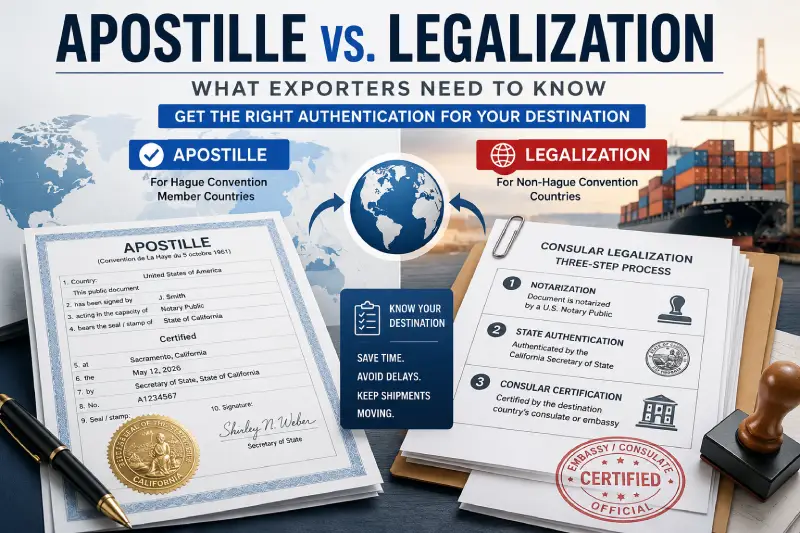
Exporters preparing documents for international use frequently run into a question they were not expecting: does this document need an apostille or legalization? Both are forms of authentication that make official documents valid in foreign countries, but they follow different procedures, involve different government authorities, and apply to different destinations. Submitting the wrong one results in document rejection and delays, often at a point in the export process where timing is critical.
This guide explains the difference clearly, identifies which method applies based on the destination country, and walks through the process for both, so that exporters can get the right authentication the first time.
What Is An Apostille?
An apostille is a standardized certificate attached to a public document that authenticates it for use in countries that are members of the Hague Convention of 1961, formally titled the Hague Convention Abolishing the Requirement of Legalisation for Foreign Public Documents. The apostille serves as a simplified alternative to the full legalization chain, streamlining cross-border document acceptance among member countries.
The Hague Apostille Convention
As of 2026, more than 120 countries are members of the Hague Apostille Convention, including the United States, Canada, most of Europe, much of Latin America, South Korea, Japan, South Africa, India, and Australia. When an exporter sends a document to any of these countries for official use, an apostille issued by the appropriate US authority is the correct and sufficient form of authentication. The receiving country’s government is legally bound to accept the apostille under the convention without requiring any additional authentication.
Which Documents Can Receive an Apostille?
Apostilles authenticate public documents, meaning documents that originate from or have been certified by a government authority or a notary public acting in an official capacity. Common export-related documents that can receive an apostille include certificates of origin, certificates of free sale, powers of attorney, notarized commercial invoices, GMP certificates issued by a recognized chamber or certified by a notary, and corporate documents such as articles of incorporation.
Purely private commercial documents, such as an unsigned commercial invoice or a purchase order, cannot receive an apostille in their basic form. They must first be notarized to become public documents before apostille certification is possible.
What Is Consular Legalization?
Consular legalization is the authentication process required for documents intended for use in countries that are not members of the Hague Convention. Unlike an apostille, which involves a single certificate from a designated US authority, consular legalization is a multi-step chain that typically involves three stages: notarization, state-level authentication, and authentication by the destination country’s embassy or consulate in the United States.
Which Countries Require Legalization Instead of an Apostille?
Countries that are not members of the Hague Convention do not recognize apostilles and require full consular legalization. As of 2026, notable non-Hague countries that exporters frequently deal with include China, Saudi Arabia, the United Arab Emirates, Qatar, Kuwait, Vietnam, Thailand, Malaysia, and many countries in Africa. The specific requirement can vary by document type even within the same country, so confirming with the destination country’s consulate or your trade specialist before beginning authentication is worth doing.
The Legalization Chain: Three Steps
- Step one is notarization. The document must first be signed or certified by a licensed notary public in the United States. The notary’s signature and seal make the document a public document eligible for further authentication.
- Step two is state authentication. The notary’s credentials must be verified by the secretary of state of the state where the notary is licensed. In California, this means submitting the notarized document to the California Secretary of State’s office for an authentication certificate confirming that the notary’s commission is valid.
- Step three is consular certification. The state-authenticated document is then submitted to the embassy or consulate of the destination country in the United States. The consulate verifies the state authentication and certifies the document for official use in their country. This is the step that gives the document legal validity in the destination market.
Which One Does Your Export Document Need?
The decision is straightforward once you know the destination country’s status under the Hague Convention. If the destination country is a Hague Convention member, an apostille is the correct and sufficient authentication. If the destination country is not a Hague Convention member, consular legalization is required.
For common export documents, the authentication path breaks down as follows. A certificate of origin issued by WTC Northern California for shipment to a Hague Convention member country needs an apostille. The same certificate going to China needs consular legalization through the Chinese consulate. A certificate of free sale for the European Union needs an apostille. A certificate of free sale for Saudi Arabia needs legalization through the Saudi consulate. A GMP certificate destined for Korea can be apostilled. The same certificate going to Indonesia requires consular legalization.
When in doubt, check the current Hague Conference on Private International Law (HCCH) status list, maintained online and updated as countries join. Trade specialists at WTC Northern California can also confirm the requirement for specific document and destination combinations.
The Apostille Process In The US
Who Issues Apostilles in California
In the United States, apostilles for state-issued or state-level documents are issued by the secretary of state of the state where the document originates or where the notarization was performed. For California exporters, the California Secretary of State issues apostilles for documents notarized in California or issued by California government authorities. Federal documents, such as those issued by a federal agency, require an apostille from the US Department of State in Washington, D.C.
Processing Time and Cost
The California Secretary of State offers both in-person and mail-based apostille processing. Processing times range from a few days for in-person submissions to several weeks by mail during high-demand periods. Expedited processing is available for time-sensitive situations at an additional cost. Confirming current fees and processing times before submitting is advisable, as these change periodically.
The Consular Legalization Process
Step-by-Step for California Exporters
For California exporters, consular legalization begins with notarization in California. The notarized document is then submitted to the California Secretary of State for an authentication certificate. This authentication is then presented to the destination country’s consulate or embassy, along with any required forms, fees, and supporting materials specified by that consulate.
Consulates vary significantly in their requirements, processing times, and procedures. Some accept mail submissions; others require in-person appointments. Some process documents within a few business days; others take several weeks. For destinations like Saudi Arabia and the UAE, where legalization is a standard part of the export documentation process, working with an experienced document preparation service that knows the specific consulate’s current requirements can significantly reduce processing time and error rates.
Countries That Commonly Require Legalization for Export Documents
Exporters dealing with China, Saudi Arabia, UAE, Qatar, Kuwait, Oman, Vietnam, Thailand, and several African markets should plan for consular legalization as a standard part of the documentation process. For businesses with regular export activity to these markets, building the legalization timeline into the production and shipping schedule prevents the last-minute scrambles that lead to shipment delays.
How WTC Northern California Can Help With Document Authentication
WTC Northern California issues certificates of origin, certificates of free sale, and other export documents that frequently require authentication. While WTC NorCal does not issue apostilles or perform consular legalization directly (those processes involve state government and foreign consular authorities), WTC NorCal trade specialists can guide exporters through which authentication their specific document requires based on the destination country, what the preparation steps are, and how to sequence authentication alongside the rest of the document package.
For documents issued through the Swiftdox platform, WTC NorCal’s digital certificates include digital signatures and blockchain verification. Many importing countries that have moved toward electronic document acceptance no longer require apostille or legalization for digital certificates from recognized issuing bodies. Confirming with the destination country’s import authority whether they accept digital certificates without physical authentication is a step worth taking, as it can eliminate the apostille or legalization step for eligible destinations. Contact the WTC NorCal trade team at (916) 447-9827 to confirm authentication requirements for your specific shipment.
Frequently Asked Questions About Apostille Vs. Legalization
What is the difference between an apostille and legalization?
An apostille is a single-step authentication certificate issued under the Hague Convention of 1961 that makes a document valid in any of the 120+ member countries. Legalization is a multi-step process required for countries that are not Hague Convention members, involving notarization, state authentication, and certification by the destination country’s consulate. The destination country’s Hague membership determines which process applies.
Which countries require an apostille for export documents?
Countries that are members of the Hague Convention of 1961 accept apostilles for document authentication. This includes major US trading partners such as Germany, France, Spain, Mexico, Brazil, South Korea, Japan, Australia, South Africa, and India, among more than 120 member countries. A current list is maintained by the Hague Conference on Private International Law (HCCH).
Which countries require consular legalization instead of an apostille?
Countries that are not Hague Convention members require consular legalization. As of 2026, this includes China, Saudi Arabia, the United Arab Emirates, Qatar, Kuwait, Vietnam, Thailand, Malaysia, and many countries in Africa. For export documentation going to these markets, the document must go through notarization, state-level authentication, and certification by the destination country’s consulate before it will be accepted.
How do I get an apostille in California?
In California, apostilles for state-level documents and notarized documents are issued by the California Secretary of State. Submit the notarized document to the Secretary of State’s office with the required form and fee. Processing times vary by submission method. For federal documents, the US Department of State in Washington, D.C., issues the apostille.
Do export documents need an apostille or legalization?
It depends on the destination country. Certificates of origin, certificates of free sale, GMP certificates, and other export documents require authentication (apostille or legalization) only when the importing country requires it for official acceptance. Most Hague Convention members require an apostille; non-Hague countries require consular legalization. Some countries that accept digital certificates with electronic signatures may not require physical authentication at all.