
Free Export Training Programs for US Small Businesses in 2026
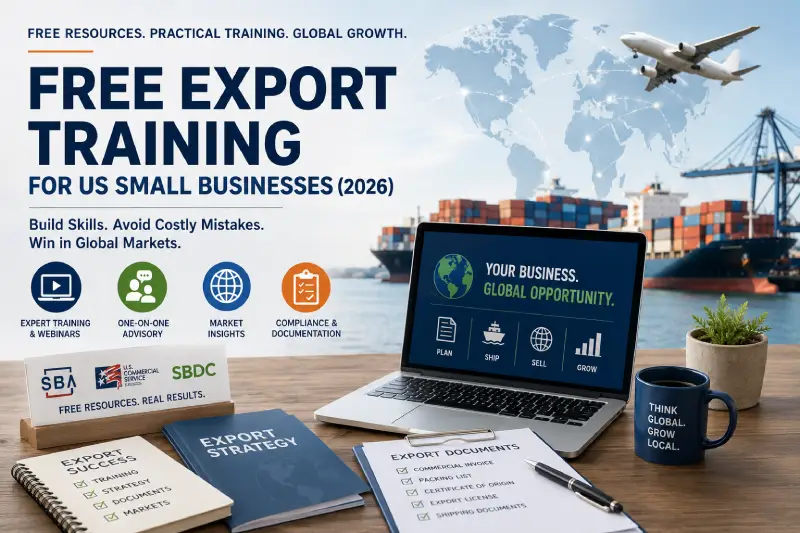
Export education is among the least expensive investments a small business can make toward growing revenue, and most of it costs nothing at all. A substantial network of government-funded, nonprofit, and trade organization programs exists specifically to help US small businesses understand how to export, identify markets, navigate compliance, and avoid the mistakes that delay or derail first attempts at international trade.
This guide covers the main free export training resources available to US small businesses in 2026, what to look for when evaluating a program, and how to use training as the foundation for a real export strategy rather than just a learning exercise.
Why Export Training Matters For Small Businesses
The data on export training outcomes is straightforward: small businesses that receive structured export education before attempting international sales are more likely to complete successful transactions, maintain customer relationships across borders, and sustain export activity over multiple years. The US Small Business Administration and the Department of Commerce have consistently found that access to trade knowledge, not capital, is the primary constraint for most small businesses considering export for the first time.
The cost of getting export fundamentals wrong is not trivial. Incorrectly classified goods face tariff penalties. Documentation errors cause customs holds. Mispriced export quotes eliminate margin. Missing regulatory requirements for a destination market can result in shipment refusal. Export training programs exist to close the knowledge gap before those errors happen, not after. For a small business with limited capital to absorb costly mistakes, that timing matters.
The Main Free Export Training Resources in the US (2026)
SBA-Funded SBDC Export Advisors
The Small Business Administration funds a national network of Small Business Development Centers that provide no-cost, confidential business advising to small business owners. Within that network, SBDC international trade advisors specialize in export readiness assessments, market selection, export pricing, documentation requirements, and connecting businesses to additional trade resources. In Northern California, the SBDC network serves Sacramento and surrounding counties, with export-specific advisors available to meet individually with business owners at no charge.
SBDC export advising is not a lecture series. It is a working session with a specialist who has direct experience in international trade, tailored to your specific product, industry, and target market. For most first-time exporters, this is the highest-value free resource available, and it is consistently underused.
US Commercial Service Training Events and Webinars
The US Commercial Service, the trade promotion arm of the Department of Commerce, offers a continuous calendar of export training events, webinars, and market briefings throughout the year. Topics range from country-specific market briefings for major export destinations to compliance training for export licensing, trade finance workshops, and documentation seminars. Many events are free or low-cost, and the Commercial Service offices in Northern California regularly host Sacramento-area business roundtables and sector-specific workshops.
WTC Northern California Export Education Events
WTC Northern California runs export education programming throughout the year for members and the broader regional business community. Events cover export documentation processes, trade compliance fundamentals, market-entry strategies for specific regions, and practical workshops on export readiness. The WTC NorCal annual programming calendar includes both member-only sessions and open events accessible to Northern California businesses regardless of membership status.
Members of WTC Northern California have access to trade specialists on an ongoing basis, not just during scheduled events. This means that export questions arising mid-shipment have a resource to go to, not just pre-export planning questions. For businesses with active export programs or serious intentions to build one, this ongoing access is often the most valuable part of membership.
Online Training Resources: Census Bureau, SBA Learning Center, and EXIM
The US Census Bureau offers free online training for the Automated Export System (AES) and Electronic Export Information (EEI) filing through its Automated Commercial Environment (ACE) platform. This training is practical and mandatory-knowledge territory for any business filing its own export declarations.
The SBA Learning Center includes free online modules on export fundamentals, trade finance, and international market research. The Export-Import Bank of the United States (EXIM) provides educational resources on trade finance mechanisms, including export credit insurance and working capital guarantees, which are directly relevant to businesses concerned about payment risk in international transactions. Understanding EXIM programs is useful groundwork even for small businesses that will not immediately use EXIM financing.
What To Look For In An Export Training Program
Not all export training is equally useful, and the form it takes matters for how actionable it becomes. When evaluating a program, a few criteria separate high-value training from general education that does not move the needle.
Market specificity matters. A general introduction to exporting is useful once. After that, market-specific training for your target destinations, covering regulatory requirements, cultural negotiation norms, payment practices, and distributor relationship structures, produces more practical returns than repeat exposure to general content.
Documentation training is foundational. If a training program does not cover the actual documents required for export transactions, how to prepare them, who issues them, and what errors to avoid, it is leaving out the part of exporting that most often causes problems.
Compliance and classification training matters for any business dealing in regulated products or technologies. Export controls, product classification, and destination restrictions are areas where mistakes can have consequences beyond delayed shipments. Programs offered by the US Commercial Service and the Bureau of Industry and Security (BIS) cover these topics at the level of practical application, not just theory.
Export Accelerator And Intensive Programs
Beyond ongoing training resources, several intensive programs are designed to move small businesses from export-ready to actively exporting within a defined cohort period.
California’s State Trade Expansion Program (STEP), administered through the Governor’s Office of Business and Economic Development (GO-Biz), has historically provided grant funding to help California small businesses participate in export trade missions, international trade shows, and market entry activities. Eligibility and funding availability vary by program year; Sacramento-area businesses should check current STEP program status through GO-Biz or through WTC NorCal, which participates in state trade programming.
World Trade Week events, held annually in May through World Trade Centers and trade organizations across the country, typically feature concentrated programming on export fundamentals, market briefings, and networking with trade specialists. WTC Northern California hosts World Trade Week programming for the Sacramento region, and attendance is generally free or low-cost.

How WTC Northern California Supports Export Education
WTC Northern California‘s role in export education extends beyond event programming. Trade specialists at WTC NorCal work with member companies individually to identify documentation requirements, map out export strategies, navigate trade compliance questions, and connect businesses with the global WTC network spanning more than 100 countries.
For businesses that need to quickly understand the documentation side of exporting, WTC NorCal’s export documentation services via the Swiftdox platform provide a practical introduction to what documents are required and how the issuance process works. Certificates of origin, certificates of free sale, and GMP certificates are all processable online, with trade specialists available to answer questions about what each document covers and when it is required.
Becoming a WTC Northern California member opens access to all of these resources at reduced cost, plus direct connections to World Trade Centers in target export markets, trade missions, and the network’s global business matchmaking capabilities. For Sacramento and Northern California small businesses building toward international sales, it is the trade infrastructure that most are not fully using. Contact WTC Northern California at (916) 447-9827 or through the website to learn about membership and current training programming.
Frequently Asked Questions About Free Export Training
What free export training is available for small businesses?
Free export training resources for US small businesses include no-cost advising through SBA-funded Small Business Development Centers (SBDCs), webinars and market briefings from the US Commercial Service, online training from the SBA Learning Center and US Census Bureau, and export education events from regional trade organizations such as WTC Northern California.
Does the SBA offer export training?
Yes. The SBA funds a national network of Small Business Development Centers that provide no-cost export advising, and the SBA Learning Center offers free online modules on export fundamentals and trade finance. The SBA also administers export financing programs including Export Express loans and International Trade loans that complement training with access to capital.
What is a trade accelerator program for exporters?
An export accelerator is an intensive program that takes businesses through the steps of developing an export plan, selecting target markets, completing regulatory compliance requirements, and identifying buyers or distributors within a structured cohort period. California’s State Trade Expansion Program (STEP) has supported small business participation in these programs, including trade missions and international trade show participation.
Where can I learn to export in Northern California?
Northern California exporters can access free export advising through the local SBDC network, export education events through WTC Northern California, and training webinars from the US Commercial Service’s Northern California offices. WTC NorCal, headquartered in Sacramento, provides ongoing trade advisory support and documentation services for member businesses throughout the region.
Is export training worth it for small businesses?
Export training consistently improves outcomes for small businesses attempting to enter international markets. SBA and Commerce Department research indicates that businesses that receive export education before their first transaction are more likely to complete successful sales, avoid documentation and compliance errors, and sustain export activity over time. Given that most foundational export training is free, the cost-benefit calculation is strongly positive.