
How to Fill Out a Certificate of Origin Form: Step-by-Step Instructions

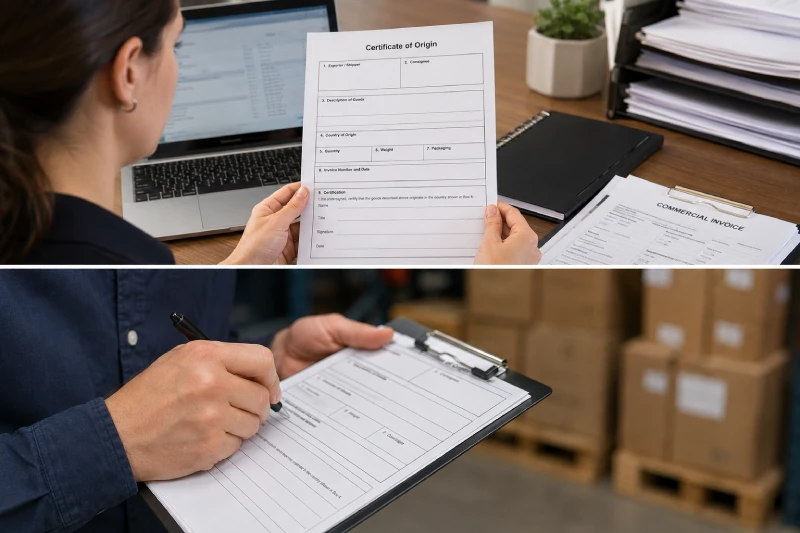
A certificate of origin is one of the most commonly required export documents, and one of the most consistently filled out with avoidable errors. The form looks straightforward. It has labeled fields, and the instructions seem self-explanatory. But a mismatched invoice number, a vague goods description, or an incorrect country of origin entry can cause a customs hold at the destination, a rejection from the certifying body, or, in the case of preferential tariff claims, a financial penalty for the importer. This guide walks through every field on a standard COO form and explains exactly what each one requires.
WHAT A CERTIFICATE OF ORIGIN FORM IS
A certificate of origin (COO) is an official export document that certifies the country in which the goods described were manufactured, produced, or substantially transformed. Foreign customs authorities use it to determine which tariff rates apply, verify compliance with import restrictions, and confirm country-of-origin labeling requirements. In many cases, an importer claiming preferential duty rates under a free trade agreement cannot do so without a valid certificate of origin.
The COO is not the same as a commercial invoice, which records the financial transaction, or a packing list, which describes the physical packaging. All three documents are typically required together, but they serve different functions. The certificate of origin is specifically about where the goods came from, not what they cost or how they are packed.
THE STANDARD FIELDS ON A CERTIFICATE OF ORIGIN FORM
Exporter / Shipper Information
This section identifies the company or individual shipping the goods. Enter the full legal business name as it appears on your business registration, the complete street address (not a P.O. Box), the city, state, zip code, and country. The name here must match the name on the commercial invoice exactly. Discrepancies between these two documents are a leading cause of rejection at the certifying body.
Consignee Information
The consignee is the party receiving the goods at the destination. This may be the buyer directly or a freight forwarder or customs broker acting on their behalf. Enter the full name, address, and country. If the consignee is “to order” (common in transactions involving letters of credit with a negotiable bill of lading), write “To Order” in this field. Do not leave it blank.
Description of Goods
This is the field that most frequently causes problems. The description must be specific enough to identify the goods clearly: what they are, what they are made of, and what they are used for if the category is broad. Writing “machine parts” is insufficient; “stainless steel hydraulic valve fittings, HS code 8484.10” is sufficient. The description should match the description on the commercial invoice, but it does not need to be copied word for word. It does need to be unambiguous.
Country of Origin
This is the country where the goods were manufactured or, in the case of products with components from multiple countries, where they were substantially transformed. Determining the correct country of origin is a legal question when multiple countries are involved, and it is addressed in more detail in a separate guide on country of origin determination. For most goods manufactured entirely within the United States, the entry is straightforward: “United States of America” or “USA.”
Quantity, Weight, and Packaging
Enter the number of units, cartons, pallets, or containers as applicable, the gross weight (and net weight if required by the destination country), and the type of packaging. These figures must match the packing list. Any discrepancy between the COO and the packing list will be caught during customs examination and can result in delays.
Invoice Number and Date
The commercial invoice number ties the certificate of origin to the specific transaction it covers. Enter the invoice number exactly as it appears on the invoice, and the invoice date. If a shipment covers multiple invoices, list all relevant invoice numbers. A COO that references a different invoice number than the one the importer presents to customs will not be accepted as proof of origin for that shipment.
Certification Declaration and Signature
The certification declaration is where the exporter attests that the information provided is accurate and that the goods described are of the country of origin stated. This is a legal declaration. Sign with the name and title of an authorized representative of the exporting company. Some certifying bodies require a notarized signature; most chambers of commerce, including WTC Northern California, do not require notarization for standard certifications but do require the signature to match the business registration on file.
STEP-BY-STEP: HOW TO COMPLETE EACH FIELD WITHOUT ERRORS
Work through the form in this order to avoid the most common sequencing mistakes.
- Start with the exporter and consignee sections and confirm both names match the commercial invoice before moving to the goods description. Pull the exact legal name from your business registration and the buyer’s exact legal name from the purchase order or trade contract.
- Write the goods description before filling in quantity and weight. The description locks in the product identity, and the quantity fields follow from it. Do not reverse this sequence; filling in quantities first leads to vague descriptions written to fit the numbers rather than descriptions written to accurately represent the goods.
- Cross-reference the invoice number before signing. Open the commercial invoice in one window and the COO form in another and verify that the invoice number, date, and goods description are consistent. This takes two minutes and eliminates the most common cause of rejection.
- Sign only after reviewing the complete form. The signature is a legal declaration. If any field is incorrect or uncertain, resolve it before signing. Submitting an inaccurate COO, even unintentionally, creates liability for the exporter.
COMMON ERRORS THAT CAUSE REJECTION OR CUSTOMS DELAYS
The certifying body most commonly rejects COO applications for these reasons: the exporter name on the COO does not match the company name on the invoice; the goods description is too vague to identify the product category; the country of origin listed does not match the supporting documentation; the invoice number on the COO does not match the invoice submitted; or the form is signed by someone whose name is not on the authorized signatories list registered with the chamber.
At customs, the most common problem is a mismatch between the COO and the packing list or commercial invoice. A COO that says 500 units and a packing list that says 480 units will trigger an examination. A COO that describes “electronics components” and an invoice that specifies “printed circuit board assemblies” may be accepted, but it introduces an unnecessary question that customs officers have to resolve, which costs time.
Expired certifications are less common but worth knowing: a COO is not a standing document. It covers a specific shipment. Some destination countries also have requirements on when a COO can be issued relative to the shipment date. If your COO was certified more than 12 months before the import date in a destination that has this requirement, it may not be accepted.
CERTIFICATE OF ORIGIN TEMPLATES AND FORMATS
There is no single universal COO form. The format used depends on the destination country and whether a trade agreement is in play.
The generic certificate of origin is a standardized commercial document used for most non-preferential shipments. This is the form WTC Northern California issues through the Swiftdox platform. It covers the standard fields described above and is accepted by customs authorities worldwide for general trade purposes.
Trade agreement-specific forms have additional requirements. The USMCA certificate of origin, which replaced the NAFTA certificate, has specific fields for tariff classification codes, preference criteria, and producer certification that are not on a generic COO. If you are claiming preferential duty rates under USMCA for shipments to Canada or Mexico, you must use the USMCA-specific certification format or include the required certifier statement on a commercial invoice. The Arab League certificate of origin, required for shipments to members of the Arab League, has its own format requirements and typically requires both chamber certification and consular legalization.
HOW TO GET YOUR CERTIFICATE OF ORIGIN CERTIFIED IN NORTHERN CALIFORNIA
WTC Northern California certifies certificates of origin for Northern California exporters through the Swiftdox digital platform. The application is submitted online. You upload the completed form and the supporting commercial invoice, the WTC NorCal trade team reviews both documents for consistency, and the certificate is issued digitally with an official certification, electronic signature, and blockchain verification.
Most applications are processed within one business day. Members of WTC Northern California pay $45 per certificate of origin; non-members pay $70. For businesses with frequent export activity, the cumulative savings through membership, combined with access to trade advisory support, make membership cost-effective for businesses certifying three or more documents per year. Reach the trade team at (916) 447-9827 or through the export documentation page on the website.
FREQUENTLY ASKED QUESTIONS ABOUT THE CERTIFICATE OF ORIGIN FORM
- What is a certificate of origin form? – A certificate of origin form is the official document on which an exporter declares and a recognized authority certifies the country in which exported goods were manufactured or substantially produced. It is used by foreign customs authorities to determine tariff rates, verify trade agreement eligibility, and enforce import regulations. The form must be completed accurately and certified by an authorized body such as a chamber of commerce before submission.
- Who fills out the certificate of origin? – The exporter fills out the certificate of origin form, providing the goods description, quantities, invoice reference, and country of origin information. The certifying body, typically a recognized chamber of commerce such as WTC Northern California, reviews the completed form and the supporting commercial invoice, then certifies and issues the official document. The exporter signs the form; the certifying body applies its seal and certification.
- What information goes in the certificate of origin? – A standard certificate of origin includes the exporter’s name and address, the consignee’s name and address, the country of origin, a description of the goods, the quantity and weight, the commercial invoice number and date, the destination country, and the exporter’s signed declaration. Trade agreement-specific forms may require additional fields such as tariff classification codes and preference criteria.
- How long does it take to get a certificate of origin certified? – WTC Northern California certifies certificates of origin within one business day through the Swiftdox digital platform. Applications are submitted online, and the certified document is returned digitally with an electronic signature and blockchain verification, which is accepted by customs authorities worldwide.
- What happens if my certificate of origin has an error? – If a certificate of origin contains an error, the certifying body will typically reject the application and ask for a corrected submission. If the error is discovered after the document has already been issued and submitted to customs, the exporter may need to apply for a corrected or replacement certificate. Errors discovered at customs can cause shipment delays. This is why cross-referencing the COO against the commercial invoice before submission is a required step in the completion process.