
Certificate of Free Sale from the FDA vs. Chamber of Commerce: What Is the Difference?
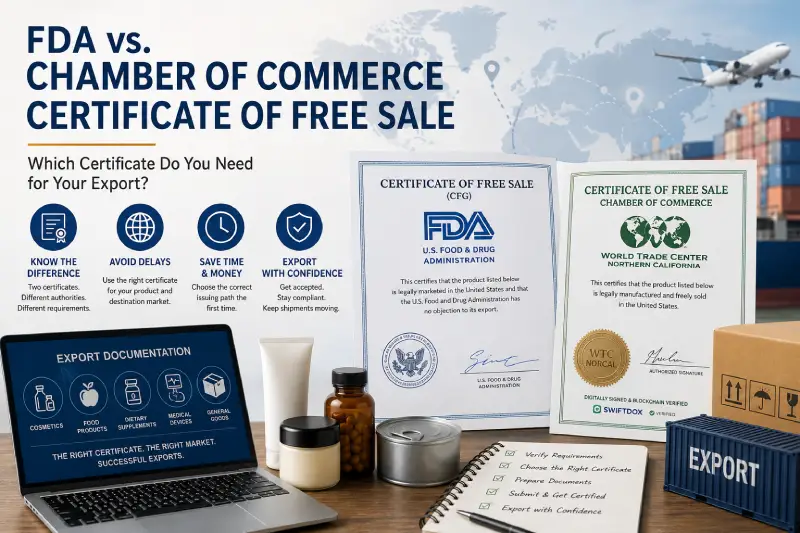
When an importing country asks an exporter for a certificate of free sale, it is asking for proof that the product is legally manufactured and freely sold in the United States. What many exporters do not immediately understand is that there are two different issuing paths for this certificate: through the US Food and Drug Administration or through a recognized chamber of commerce. Both produce a certificate of free sale, but they are different documents, issued for different product categories, through different processes, and accepted under different conditions by different markets.
Getting this distinction wrong means either applying to the wrong authority, waiting for an FDA certificate that you did not need, or submitting a chamber-issued certificate to a market that specifically requires the FDA version. This guide explains both clearly, identifies which one applies to your product and destination, and walks through how to get either.
What Is An FDA Certificate Of Free Sale?
The FDA issues certificates of free sale for certain food and cosmetic products through its Certificate to Foreign Government (CFG) program. The CFG program is the official mechanism by which the FDA certifies, upon request, that specific food or cosmetic products are legally marketed in the United States and that the FDA has no objection to their export.
Which Products Does the FDA Issue CFS Documents For
The FDA’s CFG program covers human food and cosmetics. For food products, the FDA can issue a certificate confirming that the product is legally marketed in the United States and that it is not manufactured, processed, packed, or held under insanitary conditions. For cosmetics, the FDA can issue a certificate stating that the product is legally marketed in the US, that the FDA has not taken action to remove it from the market, and that the manufacturing facility is registered with the FDA.
The FDA does not issue CFG certificates for dietary supplements, medical devices, or drugs through this same program. Those categories have separate pathways: medical devices use the Certificate to Foreign Government under the Medical Device Amendments, drugs use the export certification process under the FD&C Act’s drug provisions, and dietary supplements are generally handled through chamber-issued certificates of free sale.
What the FDA Certificate Actually Certifies
The FDA certificate of free sale certifies that the product is legally marketed in the US, that the FDA has no objection to its export, and (for food) that the facility where it is manufactured is registered with the FDA. It does not certify that the product has been approved by the FDA in the way a drug approval would work. The FDA does not pre-approve food or cosmetics for the market. What the certificate documents is the absence of prohibition, not the presence of explicit regulatory approval.
This distinction matters when presenting the certificate to a foreign regulatory authority. Some importing countries interpret FDA CFG language as a stronger endorsement than it technically represents. Export specialists and in-country regulatory consultants can help frame the certificate correctly within the destination country’s registration system.
Processing Time and Cost
FDA CFG certificate applications are submitted through the FDA Industry Systems portal. Processing times vary by product category, application volume, and whether the submission requires additional review. Many applications take several weeks to process. For exporters with time-sensitive shipments, this timeline needs to be built into the pre-shipment planning schedule. The FDA does not charge a fee for CFG certificates as of current policy, though preparing a complete application may involve costs in staff time and, for first-time applicants, potentially professional assistance.
What Is A Chamber Of Commerce Certificate Of Free Sale?
A chamber of commerce certificate of free sale is issued by a recognized chamber of commerce or accredited trade organization, certifying that a product is legally manufactured and freely sold in the United States. The chamber is not a regulatory agency and does not conduct inspections. What it certifies is that, based on the documentation submitted by the applicant, the product is legally sold in the US market without restriction.
Who Can Issue a Chamber CFS?
Not every chamber of commerce can issue a certificate of free sale that importing countries will accept. The chamber must be a recognized issuing authority, which typically means membership in and recognition by national and international chamber networks, state-level accreditation, or explicit designation as an accepted issuing body by the importing country’s authority. WTC Northern California is a recognized issuing authority for certificates of free sale and certificates of origin for Northern California exporters.
What the Chamber-Issued CFS Certifies
A chamber-issued CFS certifies that the product described in the application is legally manufactured and freely sold in the US, based on the documentation and declarations provided by the applicant. The certificate carries the chamber’s official seal and signature, and in the case of WTC Northern California, includes a digital signature and blockchain verification through the Swiftdox platform, which provides a higher level of fraud resistance than a paper-stamped certificate.
When a Chamber-Issued CFS Is Accepted
For most non-pharmaceutical export categories, including food products, cosmetics, dietary supplements, medical devices (for many markets), and general commercial goods, a chamber-issued certificate of free sale is the standard and accepted document. The vast majority of importing countries that require a CFS will accept a chamber-issued certificate from a recognized US chamber for these product categories. The FDA-issued CFG is specifically required by certain countries for specific product categories, typically where the importing country’s regulatory authority explicitly specifies that the certificate must come from a US federal regulatory agency.
FDA Vs. Chamber Of Commerce CFS: Side-By-Side Comparison
| FDA Certificate (CFG) | Chamber of Commerce CFS | |
| Issuing Authority | US Food and Drug Administration | Recognized chamber / accredited organization (e.g., WTC Northern California) |
| Products Covered | Human food, cosmetics (specific categories) | Food, cosmetics, dietary supplements, medical devices, general goods |
| Processing Time | Several weeks (varies) | Typically 1 business day (SwiftDox digital issuance) |
| Cost | No fee (application prep costs may apply) | Members: $110 | Non-members: $150 (WTC NorCal rates) |
| Digital Issuance | Electronic portal submission; PDF output | Fully digital with e-signature and blockchain verification |
| When Required | When the importing country specifically requires FDA authority | Standard for most non-pharmaceutical product categories |
| Market Acceptance | China NMPA (cosmetics), some ME health authorities | Most importing countries for non-pharmaceutical goods |
Which Markets Require An FDA-Issued CFS?
The number of markets that specifically require an FDA-issued certificate of free sale, as opposed to a chamber-issued certificate, is smaller than many exporters assume. The clearest cases involve cosmetics entering China through the National Medical Products Administration (NMPA) registration system, where the NMPA historically has specified that the CFS must come from the relevant US regulatory authority. Similarly, some Middle Eastern markets require FDA-issued certificates for certain regulated food and cosmetic categories as part of their product registration applications.
Even in these cases, the requirement is not always absolute or uniformly enforced, and it can change as bilateral trade relationships and regulatory harmonization efforts evolve. Verifying the current requirement with the destination country’s regulatory authority, your in-country importer, or a trade specialist before spending weeks waiting for an FDA CFG certificate is worth doing, especially for new market entries.
Which Markets Accept A Chamber-Issued CFS?
For the majority of the world’s import markets and the majority of non-pharmaceutical product categories, a chamber-issued certificate of free sale from a recognized US chamber of commerce is the standard and accepted document. Markets in Latin America, Southeast Asia, the Middle East (for many categories), Africa, and elsewhere routinely accept chamber-issued CFS documents for cosmetics, food products, dietary supplements, and medical devices without requiring FDA authority.
The recognition of chamber-issued CFS documents is reinforced by the international chamber network. WTC Northern California is part of the World Trade Centers Association, whose members operate in more than 100 countries. Recognition within this network contributes to the authority and acceptance of documents issued by WTC NorCal in markets where chamber-issued documents are the norm.
How WTC Northern California Issues The Certificate Of Free Sale
WTC Northern California issues certificates of free sale for Northern California exporters through the Swiftdox digital platform. The application is submitted online. You provide product information, a product label or description, documentation confirming US market availability, and your business registration information. The WTC NorCal trade team reviews the application and issues the certificate, typically within one business day.
The certificate carries WTC Northern California’s official certification, a digital signature, and blockchain verification. This verification layer provides customs authorities with a way to confirm the authenticity of the certificate independently, offering greater fraud protection than a traditional paper-stamped certificate.
Members of WTC Northern California pay $110 per certificate of free sale. Non-members pay $150. For exporters with multiple product lines or frequent export activity, the cumulative savings through WTC NorCal membership typically cover a significant portion of the annual membership cost. To apply or to confirm which type your destination requires, contact the WTC NorCal trade team at (916) 447-9827 or through the export documentation page on the website.
Frequently Asked Questions About The Certificate Of Free Sale
What is the difference between an FDA certificate of free sale and a chamber of commerce certificate of free sale?
An FDA certificate of free sale is issued by the US Food and Drug Administration through its Certificate to Foreign Government (CFG) program and covers specific food and cosmetics categories. A chamber of commerce certificate of free sale is issued by a recognized chamber or accredited trade organization and covers a broader range of product categories. The FDA version is required by certain importing countries for specific product registrations; the chamber version is accepted by most markets for most non-pharmaceutical product categories.
When do I need an FDA certificate of free sale instead of a chamber certificate?
An FDA-issued certificate is specifically required when the importing country’s regulatory authority stipulates that the CFS must come from the applicable US federal agency. This most commonly applies to cosmetics entering the Chinese NMPA registration system and some Middle Eastern market registrations for regulated food and cosmetic categories. For the majority of product categories and markets, a chamber-issued CFS from a recognized organization is accepted.
Who can issue a certificate of free sale in the United States?
In the US, certificates of free sale are issued by the FDA for eligible food and cosmetics products, by recognized chambers of commerce and accredited trade organizations for most other product categories, by the USDA for certain agricultural products, and by accredited industry associations for specific sectors. The issuing authority must be recognized by the destination country’s import authority.
How long does it take to get a certificate of free sale?
Processing time depends on the issuing authority. WTC Northern California processes certificates of free sale within one business day through the Swiftdox digital platform. FDA Certificate to Foreign Government applications typically take several weeks. Planning documentation procurement early in the export timeline, well before the shipment date, avoids delays from longer processing times.
Does the FDA charge for a certificate of free sale?
As of the current policy, the FDA does not charge an application fee for its Certificate to Foreign Government (CFG) program. However, preparing a complete and accurate application may involve staff time and, for first-time applicants, professional assistance. WTC Northern California charges $110 for members and $150 for non-members per certificate of free sale issued through the Swiftdox platform.