
GMP Standards in the Food Industry: What Exporters Need to Know
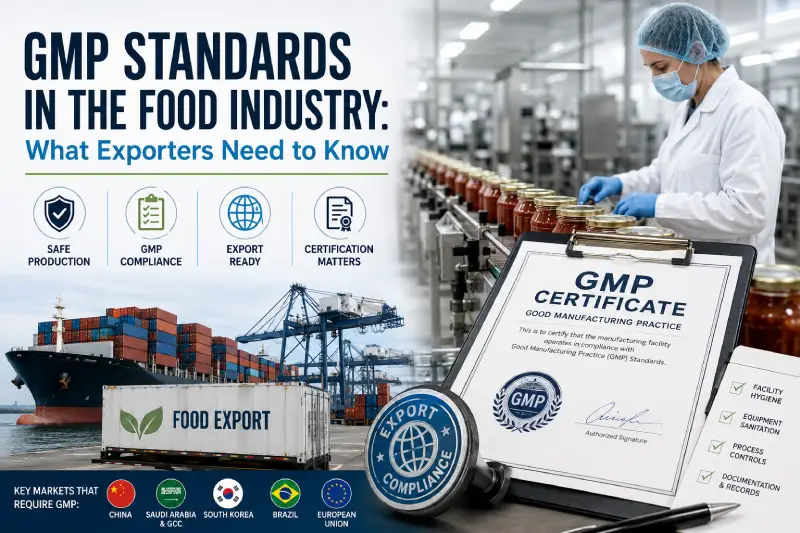
Most food manufacturers only encounter GMP export requirements when a shipment gets flagged at a foreign border. The importing country’s regulatory authority asks for proof of Good Manufacturing Practice compliance, and suddenly the exporter is trying to figure out what a GMP certificate is, who issues it, and how long it takes to get one, with a detained container sitting in a port warehouse. This guide covers all of it before that moment arrives.
What “Good Manufacturing Practice” Means In The Food Industry
Good Manufacturing Practice (GMP) is the term used to describe the minimum standards a food manufacturer must meet to ensure products are consistently produced, controlled, and safe for consumption. In the United States, the FDA codifies these requirements under 21 CFR Part 117, the Current Good Manufacturing Practice, Hazard Analysis, and Risk-Based Preventive Controls for Human Food rule, commonly called the Preventive Controls rule.
GMP requirements in food manufacturing address the entire production environment: facility design and maintenance, personal hygiene and employee health policies, equipment cleaning and sanitation, water quality and pest control, production and process controls, and record-keeping. The logic is straightforward. A product cannot consistently be safe if the conditions under which it was produced are unreliable, unsanitary, or uncontrolled.
How GMP Differs from HACCP and ISO 22000
These three terms appear together frequently enough that food exporters often treat them as interchangeable. They are not. GMP addresses the baseline manufacturing environment and hygiene conditions. Hazard Analysis and Critical Control Points (HACCP) is a systematic process for identifying and controlling specific biological, chemical, and physical hazards at defined points in the production process. ISO 22000 is an international management system standard that integrates both GMP and HACCP principles into a certifiable food safety management framework.
For export purposes, GMP compliance is often what an importing country’s customs authority or distributor will ask to see first. HACCP plans and ISO 22000 certification may be required in addition to GMP documentation for certain product categories or destination markets. Knowing which applies to your shipment depends on the destination country and what your buyer has specified in the purchase agreement.
Which Food Exporters Need A GMP Certificate?
Not every food company exporting from the United States will be asked for GMP documentation. The requirement is concentrated around three factors: the destination country’s import regulations, the product category, and the requirements of the in-country importer or distributor.
Processed and packaged foods heading to markets with formal import registration systems, including China, South Korea, Saudi Arabia, Brazil, Japan, and the member states of the European Union, are the most common trigger. Health foods, dietary supplements with food-adjacent positioning, infant formula, organic products, and specialty dietary products frequently require GMP documentation as a condition of import registration. Private-label manufacturers producing for foreign brands often face GMP requirements because the buyer needs to demonstrate to their local regulator that the source facility meets applicable standards.
If your product requires registration with the destination country’s food or health authority, assume GMP documentation will be part of the application package. Confirming this with a trade specialist before the shipment departs is substantially less expensive than resolving a customs hold after it arrives.
What A GMP Certificate For Food Export Actually Is
A GMP certificate for food export is a document issued by a recognized authority certifying that a food manufacturer operates in compliance with Good Manufacturing Practice standards. The document is not issued by the FDA automatically as a result of passing an inspection. It requires a specific application and issuance process, separate from routine regulatory oversight.
In the United States, GMP certificates for food export are typically issued through one of three channels: the FDA’s Certificate to Foreign Government (CFG) program for eligible food facilities, recognized chambers of commerce and accredited export documentation organizations like WTC Northern California, or third-party GMP audit and certification bodies whose certificates are recognized by the destination country’s import authority.
What the certificate confirms is that the manufacturer’s facility and processes meet GMP requirements as defined by US regulations, and that the product is manufactured under those conditions. It does not guarantee the product passed a specific laboratory test or that it meets the destination country’s own product standards. Those are separate documentation requirements, and confusing them is a common source of delays.
How To Get GMP Certified For Food Export
FDA’s Role in GMP Documentation
The FDA’s Certificate to Foreign Government program allows US food facilities to request an official certificate confirming they are registered with the FDA and, in some cases, that the agency has no objection to the export of the product. Not every facility or product qualifies for an FDA-issued certificate. The application process involves specific eligibility criteria and can take several weeks, making early planning essential for time-sensitive shipments.
Third-Party GMP Audits and Certification Bodies
For markets that require a certifiable GMP audit rather than a document-based certificate, third-party certification bodies conduct on-site inspections of the manufacturing facility against GMP criteria. Certifications from bodies accredited under ISO/IEC 17065 are recognized by most international import authorities. The audit scope, the standard applied (FDA GMP, EU GMP, WHO GMP), and the resulting certificate must align with what the destination country’s regulator will accept.
This process takes more time and investment than a document-based certificate, but it is often required for access to tightly regulated markets such as the EU pharmaceutical food supplement category or certain Middle Eastern health food registrations. If your export plan involves these markets, building the audit timeline into your production and logistics schedule is worth doing upfront.
The Certificate Application Process at WTC Northern California
WTC Northern California issues GMP certificates and related export documentation digitally through the Swiftdox platform. For food exporters who need a GMP certificate as part of an export documentation package, the process does not require an office visit. You submit the application online, upload your supporting documents, and the WTC NorCal trade team reviews and issues the certificate. Most applications are processed within one business day.
Members pay reduced rates on all export documentation, including GMP certificates. For food businesses with regular export programs, WTC Northern California membership typically covers its cost through accumulated document savings and the value of the trade specialist support included in membership.
Which Countries Require GMP Documentation For Imported Food?
Requirements vary by country and by product category, but several markets consistently require GMP documentation as part of food import registration or customs clearance.
- China: The General Administration of Customs of China (GACC) requires foreign food manufacturers to register with GACC before their products can be imported. GMP compliance documentation is part of the registration package for most food categories and has become a standard expectation for processors exporting packaged food, dairy, meat, and seafood products to the Chinese market.
- Saudi Arabia and the GCC: The Saudi Food and Drug Authority (SFDA) and equivalent bodies in Gulf Cooperation Council countries require GMP documentation for health foods, dietary supplements, and many processed food products as a condition of product registration.
- South Korea: The Ministry of Food and Drug Safety in Korea requires GMP compliance documentation for dietary supplements and health functional foods. Exporters of these product categories to South Korea should plan to provide GMP certification alongside their product registration applications.
- Brazil: ANVISA, Brazil’s national health regulatory agency, requires GMP documentation for regulated food categories, including dietary supplements and functional foods. The documentation must meet Brazilian GMP standards, and some manufacturers pursue certification that maps to both FDA GMP and ANVISA requirements simultaneously.
- The European Union: While EU food law is complex and depends heavily on product category, processed foods entering the EU market are subject to hygiene regulations that effectively require GMP-equivalent controls. For products positioned as health foods or supplements, GMP documentation aligned with EU standards is standard practice.
Consequences Of Exporting Without GMP Compliance Documentation
The practical consequences of shipping food to a market that requires GMP documentation without having it ready fall into two categories: customs-related delays that cost money, and regulatory-related holds that cost market access.
On the customs side, shipments without required documentation are held at the port of entry until the documentation is provided or the goods are returned or destroyed. Port storage and demurrage fees accumulate daily. For perishable food products, a multi-day documentation delay can render the entire shipment unsellable. The cost of a GMP certificate is fixed and modest. The cost of a detained perishable shipment is neither.
On the market access side, products that require import registration in the destination country cannot begin that process without complete documentation. Exporting without GMP documentation in place can mean starting the registration process over, which adds months to the timeline. In markets where registration approval is required before any commercial sale can occur, this translates directly into delayed revenue for your in-country distributor and potential damage to that relationship before it has generated a single sale.
Frequently Asked Questions About GMP In The Food Industry
What does GMP mean in the food industry?
- GMP stands for Good Manufacturing Practice. In the food industry, GMP refers to the set of regulations and standards that define the minimum conditions under which food must be manufactured, processed, packed, and held to ensure it is safe for consumption. In the United States, FDA GMP requirements for food are codified under 21 CFR Part 117.
Does the FDA require GMP for all food manufacturers?
- The FDA requires compliance with current Good Manufacturing Practice (cGMP) for most food facilities, with some exemptions for very small businesses and farms. Facilities subject to the Preventive Controls rule under 21 CFR Part 117 must implement GMP controls as a foundation for their food safety plans. FDA conducts routine inspections to verify compliance.
How do I get a GMP certificate for food export?
- GMP certificates for food export can be obtained through the FDA’s Certificate to Foreign Government program for eligible facilities, through recognized chambers of commerce and accredited export documentation organizations such as WTC Northern California, or through third-party GMP certification bodies that conduct facility audits. The right option depends on the destination country’s requirements and the product category.
Which countries require a GMP certificate for food imports?
- China, Saudi Arabia, and GCC countries, South Korea, Brazil, and the European Union commonly require GMP documentation for imported food products, particularly processed foods, health foods, dietary supplements, and infant formula. The specific requirement depends on both the product category and the destination country’s regulatory authority.
What is the difference between GMP and HACCP for food?
- GMP (Good Manufacturing Practice) covers the baseline conditions under which food is manufactured, including facility hygiene, equipment maintenance, and personnel standards. HACCP (Hazard Analysis and Critical Control Points) is a systematic process for identifying and controlling specific hazards at defined points in production. GMP establishes the foundation; HACCP addresses process-level food safety controls. Exports to regulated markets may require documentation for both.