
What Documents Do You Need to Export from California?
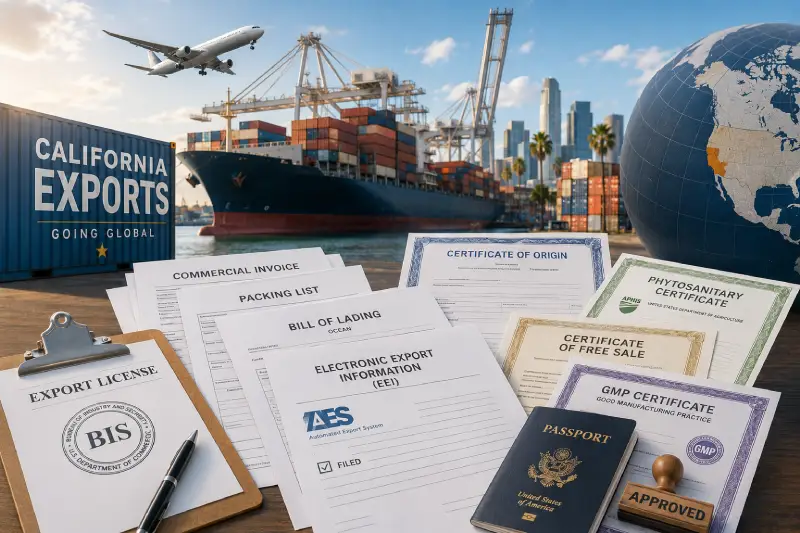
California exports more goods than any other US state, with annual export value consistently exceeding $170 billion. Agricultural products from the Central Valley, technology from the Bay Area, aerospace components from Southern California, and packaged foods from across the state move through ports in Los Angeles, Long Beach, Oakland, and Sacramento every day. Behind every one of those shipments is a document package that tells customs authorities on both sides of the transaction who shipped what, where it came from, what it’s worth, and whether it meets the destination country’s import requirements.
Getting that documentation right is not optional. Missing or incorrect documents are one of the leading causes of customs holds, shipping delays, and refused shipments. This guide covers the core export documents required for most California shipments, the destination-specific documents that apply to certain product categories, and where to obtain them quickly.
The Core Export Documents Every California Exporter Needs
Regardless of product, destination, or shipment size, most exports from California require a standard set of documentation that satisfies both US export control requirements and the receiving country’s customs clearance process.
Commercial Invoice
The commercial invoice is the primary financial document for the export transaction. It identifies the buyer and seller, describes the goods, states the quantity, unit price, and total value, and specifies the terms of sale (the Incoterms, like FOB, CIF, EXW). Foreign customs authorities use the commercial invoice to assess import duties and verify that the declared value matches what the buyer actually paid. Inaccuracies in the commercial invoice, whether honest mistakes or deliberate undervaluation, create customs problems at the destination.
Packing List
The packing list accompanies the commercial invoice and provides a detailed breakdown of how the goods are packed: the number and type of packages, the weight and dimensions of each, and the contents by package. Customs agents use the packing list to verify the physical shipment against the declared goods. For multi-product shipments or complex orders, a clear and accurate packing list significantly reduces the likelihood of a detailed customs inspection that causes delays.
Bill of Lading or Airway Bill
The bill of lading (for ocean freight) or airway bill (for air freight) is the carrier’s receipt for the goods and the contract of carriage. It confirms that the carrier received the goods in apparent good condition, specifies the origin and destination ports, identifies the shipper and consignee, and, in the case of a negotiable bill of lading, serves as a document of title. Your freight forwarder typically prepares this document, but exporters need to review it carefully, since errors in the bill of lading affect customs clearance, insurance claims, and payment under letters of credit.
Electronic Export Information (EEI)
The Electronic Export Information (EEI) is the US government’s export declaration, filed electronically through the Automated Export System (AES) via the US Census Bureau’s Automated Commercial Environment (ACE). EEI filing is required for most shipments valued over $2,500 and for all exports requiring a license, regardless of value. California exporters are responsible for ensuring the EEI is filed accurately and on time. Freight forwarders can file on your behalf if authorized.
Destination-Specific Export Documents
Beyond the standard document package, many countries require additional documentation specific to the product category, the trade relationship, or the importing country’s regulatory system. California exporters dealing in food, agriculture, health products, or regulated manufactured goods will encounter these regularly.
Certificate of Origin California
A certificate of origin certifies the country in which a product was made or substantially manufactured. Importing countries use it to determine applicable tariff rates under trade agreements, verify country-of-origin labeling requirements, and screen for trade sanctions or anti-dumping measures. For products qualifying under US trade agreements such as USMCA (Canada and Mexico), the certificate of origin enables the importer to claim preferential tariff rates, which can represent meaningful cost savings on large shipments.
In California, certificates of origin are issued by recognized chambers of commerce and accredited organizations such as WTC Northern California. The certificate is typically issued within one business day through the Swiftdox digital platform, with no office visit required. Members receive preferential pricing compared to non-member rates.
Certificate of Free Sale
A certificate of free sale certifies that a product is legally manufactured and freely sold in the United States. It is commonly required for cosmetics, dietary supplements, food products, and medical devices entering markets including China, South Korea, Southeast Asian countries, Latin American markets, and parts of the Middle East. The certificate confirms that no US regulatory prohibition exists against selling the product, giving the importing country’s authority a baseline compliance confirmation before allowing the product into their distribution channels.
Phytosanitary Certificate
Agricultural products, including fresh fruits, vegetables, grains, seeds, and plant-based raw materials, typically require a phytosanitary certificate issued by the US Department of Agriculture’s Animal and Plant Health Inspection Service (APHIS). The certificate confirms that the plants or plant products were inspected and found free of pests and diseases that the destination country is trying to keep out of its agricultural ecosystem. California’s agricultural export program is managed in coordination with the California Department of Food and Agriculture (CDFA). Exporters should confirm phytosanitary requirements with APHIS well before the shipment date.
GMP Certificate
Good Manufacturing Practice certificates are required by several importing countries for food products, health supplements, cosmetics, and medical devices. The certificate confirms that the manufacturer’s facility and processes meet GMP standards under applicable US regulations. For California food and health product exporters heading to China, South Korea, Brazil, Saudi Arabia, or the EU, a GMP certificate is frequently part of the import registration documentation package.
Regulatory Clearances And Export Licenses
When You Need an Export License
Most goods exported from California do not require a specific export license. However, certain products, technologies, and destinations require a license from the Bureau of Industry and Security (BIS) under the Export Administration Regulations (EAR), or from the State Department under the International Traffic in Arms Regulations (ITAR) for defense articles and services. Dual-use technologies, encryption software, certain chemicals, and nuclear-related equipment are among the categories most frequently subject to licensing requirements. Before assuming no license is needed, California exporters should run a classification check using the Commerce Control List (CCL) or consult with an export compliance specialist.
USDA and FDA Clearances
Products regulated by the USDA or FDA may require additional clearance documentation beyond the standard export package. USDA-regulated exports (meat, poultry, dairy, eggs, and agricultural products) may require export certificates issued through FSIS or APHIS. FDA-regulated products (food, drugs, cosmetics, medical devices) may require FDA registration confirmation and, in some cases, a Certificate to a Foreign Government. Exporters in these categories should factor agency processing times into their export schedules.
How California’s Export Requirements Compare To The Rest of the US
Federal export documentation requirements apply uniformly across all US states. There is no California-specific set of export regulations separate from federal law. However, California does have state-level agencies that affect certain product categories: the California Department of Food and Agriculture coordinates with USDA on agricultural export certification, and the California Air Resources Board (CARB) emissions standards can affect exports of certain manufactured goods, particularly vehicles and equipment, since buyers in some markets specifically request proof of CARB compliance as a quality signal.
California’s geographic position also matters operationally. The ports of Los Angeles and Long Beach together handle more container traffic than any other US port complex. Oakland is the primary port for Northern California exports, particularly agricultural products. Exporters using these ports benefit from the concentration of freight forwarders, customs brokers, and trade service providers with deep expertise in Pacific Rim trade lanes.
Where To Get Your California Export Documents
WTC Northern California issues export documentation for California businesses through the Swiftdox digital platform, including certificates of origin, certificates of free sale, and GMP certificates. Applications are submitted online, processed by the WTC NorCal trade team, and issued digitally within one business day in most cases. Digital certificates include a digital signature and blockchain verification, which are accepted by customs authorities worldwide.
For documents requiring federal agency involvement, such as phytosanitary certificates from APHIS or FDA Certificates to Foreign Government, WTC Northern California trade specialists can guide exporters through the application process and help assemble the supporting documentation required. Members have access to trade advisory support as part of their membership benefits. Reach the WTC Northern California trade team at (916) 447-9827 or through the export documentation page.
Frequently Asked Questions About Export Documents In California
What documents are required to export from California?
- Most California exports require a commercial invoice, packing list, bill of lading or airway bill, and Electronic Export Information (EEI) filing. Destination-specific documents such as certificates of origin, certificates of free sale, phytosanitary certificates, or GMP certificates are required depending on the product category and destination country.
Who issues certificates of origin in California?
- Certificates of origin in California are issued by recognized chambers of commerce and accredited export documentation organizations. WTC Northern California issues certificates of origin digitally through the Swiftdox platform, with most applications processed within one business day. Members pay $45 per certificate; non-members pay $70.
Do I need an export license to export from California?
- Most products exported from California do not require a specific export license. However, products covered under the Export Administration Regulations (EAR) or the International Traffic in Arms Regulations (ITAR), including certain technologies, chemicals, and defense-related goods, require a license from BIS or the State Department. Exporters should check the Commerce Control List before assuming no license is needed.
What is a certificate of origin and why is it required?
- A certificate of origin is an official document certifying the country where a product was manufactured or substantially produced. Importing countries use it to determine applicable tariff rates, verify compliance with trade agreements, and apply country-of-origin labeling rules. For shipments to USMCA partner countries (Canada and Mexico), a certificate of origin enables importers to claim preferential tariff rates.
How long does it take to get export documents in California?
- Certificates of origin and certificates of free sale issued through WTC Northern California are typically available within one business day of application. Federal agency documents such as phytosanitary certificates from USDA APHIS and FDA Certificates to Foreign Government have longer processing times that vary by product and application volume; exporters should plan for these well in advance.