
GMP Pharmaceutical: What It Is and Why It Matters for Exporters
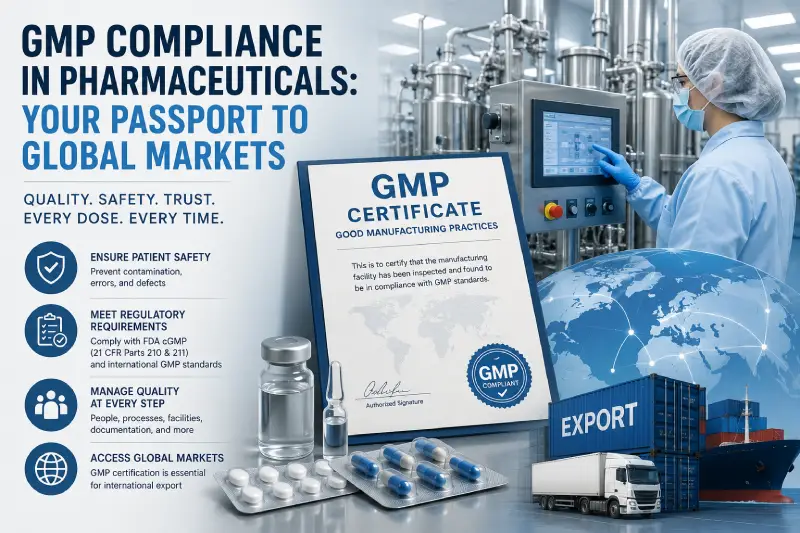
Every drug, biologic, and regulated health product that reaches a patient, whether manufactured in the United States or exported to a foreign market, is produced under a framework called Good Manufacturing Practices. For pharmaceutical manufacturers and exporters, GMP is not optional guidance: it is the regulatory baseline that determines whether your products can be sold, distributed, or shipped across a border. This guide explains what GMP means in a pharmaceutical context, what it requires, and what manufacturers exporting internationally need to know about GMP documentation.
What Is GMP in Pharmaceuticals?
GMP pharmaceutical, formally known as Good Manufacturing Practices for pharmaceuticals, is a system of regulations, guidelines, and procedures that ensure drug products are consistently produced and controlled to meet established quality standards. In the United States, GMP requirements for prescription and over-the-counter pharmaceuticals are codified under 21 CFR Parts 210 and 211, enforced by the U.S. Food and Drug Administration.
GMP covers the entire manufacturing process: raw material sourcing, facility conditions, personnel qualifications, production controls, laboratory testing, packaging, and recordkeeping. The goal is to prevent contamination, mix-ups, deviations, and errors that could result in substandard or dangerous products reaching patients.
GMP vs. cGMP: What’s the Difference?
GMP (Good Manufacturing Practices) and cGMP (Current Good Manufacturing Practices) are often used interchangeably, but there is a meaningful distinction. The “c” in cGMP refers to the expectation that manufacturers stay current, meaning they adopt up-to-date technologies, systems, and methods as the industry evolves. A facility may have met GMP standards ten years ago but no longer meets cGMP standards today if it has not kept pace with modern quality systems.
The FDA uses the term cGMP in its regulations. Internationally, the World Health Organization (WHO), the European Medicines Agency (EMA), and other regulatory bodies use GMP or equivalent terminology, though the underlying requirements differ in specifics. Manufacturers exporting pharmaceuticals must understand which standard applies to their destination market.
Why GMP Compliance Matters
A pharmaceutical consumer has no reliable way to detect whether a drug is pure, correctly dosed, or free from contamination through sight, smell, or touch. This is the core reason GMP exists. Unlike food contamination that may be visible, a pharmaceutical defect is invisible until it causes harm.
The FDA tests only a fraction of each batch; a sample of 100 tablets from a batch of two million means the vast majority of units reach patients without direct individual testing. GMP is what ensures those untested units are safe, because the entire system of manufacturing, not just the sampled product, has been built to prevent errors.
For pharmaceutical exporters, GMP compliance is also a market access requirement. Most regulated markets, including the European Union, Japan, Australia, Canada, Saudi Arabia, and China, require proof of GMP compliance before a pharmaceutical product may be imported. That proof typically takes the form of a GMP certificate issued by a recognized authority.
Core GMP Requirements for Pharmaceutical Manufacturers
GMP pharmaceutical requirements span every function involved in producing a drug product. The following areas represent the primary compliance categories audited during FDA inspections and reviewed by foreign regulatory authorities.
Personnel and Training
Every person who works in pharmaceutical manufacturing must be qualified by education, training, or documented experience for their role. This includes production staff, quality control personnel, supervisors, and management. GMP regulations require initial training before any manufacturing activity and ongoing training as processes, regulations, or equipment change. Inadequate personnel training is among the most commonly cited deficiencies in FDA Form 483 inspection observations.
Facilities and Equipment
Manufacturing facilities must be designed, maintained, and controlled to prevent contamination and mix-ups. This includes requirements for clean rooms, air filtration, water systems, temperature and humidity controls, and physical separation of different production areas. Equipment must be qualified, regularly calibrated, and documented. Facility and equipment deficiencies can trigger warning letters, import alerts, and product recalls.
Process Controls and Validation
Each step of the manufacturing process must be controlled and validated, meaning the manufacturer has documented evidence that the process consistently produces a product meeting its intended specifications. Validation applies to manufacturing processes, analytical testing methods, cleaning procedures, and computerized systems. GMP regulations require that any significant deviation from a validated process be investigated and documented before the affected batch is released.
Documentation and Record-Keeping
GMP pharmaceutical compliance runs on documentation. Batch records, standard operating procedures (SOPs), deviation reports, change controls, and laboratory results must all be accurate, complete, legible, and attributable to the person who created them. The FDA’s data integrity expectations requiring that records be ALCOA+ (Attributable, Legible, Contemporaneous, Original, Accurate, and more) apply across all GMP documentation. Inadequate documentation or data integrity failures are among the most serious GMP violations because they undermine the reliability of the entire manufacturing record.

Who Regulates GMP in the Pharmaceutical Industry?
In the United States, the FDA is the primary GMP regulatory authority for pharmaceuticals. The FDA enforces GMP through facility inspections, product sampling, import surveillance, and enforcement actions including warning letters, injunctions, seizures, and import alerts.
Internationally, the regulatory landscape includes the European Medicines Agency (EMA) and national competent authorities within the EU, the Medicines and Healthcare products Regulatory Agency (MHRA) in the UK, Health Canada, the Therapeutic Goods Administration (TGA) in Australia, and the Pharmaceuticals and Medical Devices Agency (PMDA) in Japan. The World Health Organization publishes WHO GMP guidelines that are adopted by many developing-nation regulatory agencies.
Mutual Recognition Agreements (MRAs) exist between some regulatory authorities; for example, the FDA has MRAs with the EU and several other major markets, which means a GMP inspection conducted by one authority may be accepted by another. However, this does not eliminate the need for GMP documentation; it changes who performs the inspection.
What Happens When a Pharmaceutical Company Fails a GMP Inspection?
When the FDA finds significant GMP deficiencies during an inspection, it issues a Form 483, a list of objectionable conditions observed during the inspection. The manufacturer is expected to respond within 15 business days with corrective and preventive actions (CAPAs). If the FDA determines the response is inadequate or the violations are serious, it may escalate to a Warning Letter, which is publicly posted and can trigger restrictions on product approvals and distribution.
In the most serious cases, particularly where there is a risk of patient harm, the FDA may issue an Import Alert, which effectively blocks the manufacturer’s products from entering the U.S. market. Consent decrees and product recalls are also available enforcement tools. For exporters, a foreign regulatory agency finding a GMP deficiency can result in the same outcomes in that market: shipment holds, import bans, and distribution restrictions.
GMP Certification for Export: What Pharmaceutical Manufacturers Need
A GMP certificate for export is an official document issued by a recognized authority that verifies that a pharmaceutical manufacturer’s facility and processes comply with GMP standards. It is distinct from the FDA’s cGMP inspection record. A GMP certificate is a discrete document that exporters provide to foreign regulatory agencies, importers, and distributors as part of the market entry documentation package.
Most importing countries require a GMP certificate alongside a Certificate of Free Sale, product registration dossiers, and other export documentation. The specific format, issuing authority, and validity period required vary by destination. China, India, Saudi Arabia, Brazil, the UAE, and the EU all have specific GMP documentation requirements for pharmaceutical imports.
GMP certificates are typically valid for one to two years. Manufacturers should track expiration dates carefully; an expired GMP certificate can delay or block a shipment at customs just as effectively as a missing one.
Get Your GMP Certificate Through WTC Northern California
WTC Northern California is an authorized issuer of GMP certificates for pharmaceutical, medical device, food, and cosmetics manufacturers exporting from the United States. We process applications digitally through the Swiftdox platform with turnaround in 1 to 3 business days, no office visits, no paper forms.
Member pricing starts at $150. Non-members pay $175. If your export documentation package also requires a Certificate of Free Sale or Certificate of Origin, we issue all three. Contact our trade specialists through the export documentation page to confirm what your destination market requires before you submit.