
Certificate of Free Sale for Cosmetics: What It Is and How to Get One
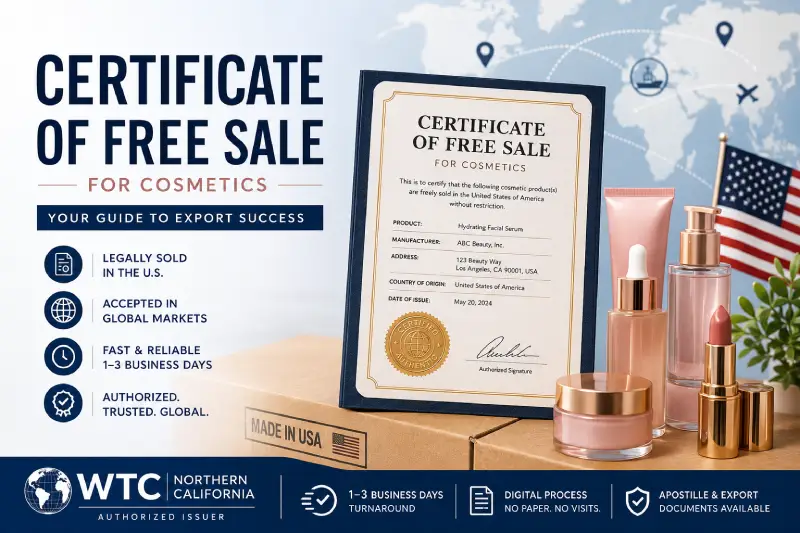
If you manufacture or export cosmetics from the United States, a certificate of free sale is one of the first export documents you will need. Most importing countries require it before your products can clear customs, and many distributors will not accept a shipment without one on file. This guide covers what a cosmetics CFS is, who issues it, and exactly how to get yours.
What Is a Certificate of Free Sale for Cosmetics?
A certificate of free sale (CFS) for cosmetics is an official document that certifies a specific cosmetic product is legally manufactured and freely sold in the United States without government restriction. It is not an approval or safety endorsement from the FDA; it is a verification that the product exists in open commerce and meets U.S. regulatory requirements as they stand.
The term “free sale” means the product is available for unrestricted purchase in the domestic market. Foreign regulatory agencies use this document to confirm that U.S. cosmetics exporters are operating under the oversight of a recognized authority and that their products meet at least the minimum standards of the country of origin.
A CFS for cosmetics typically includes the product name, manufacturer information, a declaration that the product is freely sold in the U.S., the issuing organization’s seal and signature, and an issue date. Some destination countries also require an apostille, an additional authentication step, on top of the CFS itself.
Why Importing Countries Require a CFS for Cosmetics
Foreign governments require a certificate of free sale for cosmetics because they have no direct visibility into how U.S. cosmetics are regulated. Unlike pharmaceuticals, cosmetics in the United States are not subject to pre-market FDA approval; companies are responsible for ensuring their products are safe before selling them. Importing countries want a document that confirms the product, at a minimum, clears U.S. standards and is not restricted or banned from sale.
From a distributor’s perspective, a CFS is also a risk management tool. If a foreign importer is sourcing cosmetics from a U.S. manufacturer, they need documentation they can present to customs and their own regulatory authority. A missing or expired CFS can result in customs holds, rejected shipments, and damage to the distributor relationship.
For cosmetics specifically, the CFS requirement is separate from product safety testing or ingredient compliance. You may still need to meet the destination country’s labeling requirements, restricted ingredient lists, and registration rules. The CFS is one piece of the documentation puzzle, not the entire picture.
Which Countries Require a CFS for Cosmetics?
The short answer is: most countries that your cosmetics will cross into require some form of free sale certification. The specific requirement varies by destination.
Countries with established CFS requirements for cosmetics include China, South Korea, Japan, Saudi Arabia, the United Arab Emirates, Brazil, Mexico, Indonesia, India, and most of the European Union for non-EU manufacturers. Some countries require the CFS to be issued by a government body; others accept Chamber of Commerce-issued certificates. A few markets require the document to be apostilled before it is considered valid.
If you are targeting a new export market and are unsure whether a CFS is required, the safest approach is to request it anyway. Customs authorities and regulatory bodies in most destination countries will not penalize you for providing documentation you did not strictly need, but they will delay or reject a shipment if the required paperwork is missing.
FDA-Issued vs. Chamber-Issued CFS: What’s the Difference?
There are two main types of entities authorized to issue certificates of free sale for cosmetics in the United States: the FDA and Chambers of Commerce.
FDA-issued certificates are processed through the FDA’s Export Certification program and carry the agency’s official letterhead. The FDA issues these primarily for FDA-regulated products, including cosmetics, foods, medical devices, and drugs. The process takes several weeks and involves submitting your product details, facility registration, and supporting documentation.
Chamber-issued certificates are issued by authorized Chambers of Commerce, such as World Trade Centers and affiliated trade organizations, under the authority recognized by international trade law and most importing nations. Chamber-issued CFS documents are widely accepted globally and are the more common choice for cosmetics exporters because they are faster and less bureaucratic. WTC Northern California, for example, issues Chamber-certified CFS documents through the Swiftdox platform with a turnaround of 1 to 3 business days.
The right choice depends on your destination country’s specific requirements. Some countries explicitly require an FDA-issued document; others accept either. When in doubt, confirm with your importer or the destination country’s regulatory authority.
What Documents Do You Need to Obtain a Cosmetics CFS?
The documentation required for a cosmetics certificate of free sale varies slightly by issuing authority, but the standard set includes:
- Product name and description, the exact name as it appears on the label
- Manufacturer name and U.S. business address
- Ingredient list or product formula (for some issuers)
- Proof that the product is currently sold in the U.S. (such as a product page, invoice, or retail listing)
- Company letterhead and authorized signatory details
- Destination country (some issuers require this to tailor the certificate language)
If the destination country also requires an apostille, you will need to factor in the additional authentication step after the CFS is issued. WTC Northern California handles apostille requests as part of its export documentation services, which can save you the time of going through a separate notary and state-level apostille process.

How to Get a Certificate of Free Sale for Cosmetics (Step by Step)
Getting a CFS for cosmetics is a straightforward process when you work with an authorized issuer. Here is how it works from start to finish.
Step 1: Confirm Your Product Qualifies
Your cosmetics product must be legally manufactured in the United States and actively sold in the U.S. market. Products that are manufactured in the U.S. but exclusively for export nd have never been sold domestically may not qualify for a standard CFS. If this is your situation, verify with your issuing authority before submitting documentation.
Step 2: Gather Your Product Documentation
Collect the product name, ingredient list, manufacturer details, and any available proof of U.S. sale. Having this prepared before you submit speeds up the review process. Incomplete applications are the most common cause of delays, so double-check that your business address and product description match exactly what appears on your product’s U.S. label.
Step 3: Submit Your Application Through an Authorized Issuer
You can apply directly through WTC Northern California’s export documentation portal, powered by Swiftdox. The application is entirely digital: no office visits, no paper forms. After submission, the WTC’s trade specialists review the application for completeness and compliance before issuing the certificate. Turnaround is typically 1 to 3 business days.
Step 4: Receive and Verify Your Certificate
Once issued, your certificate of free sale for cosmetics is delivered digitally. Download it, verify that all product and manufacturer details are accurate, and share it with your importer or freight forwarder. If your destination country requires an apostille, initiate that step immediately so it does not delay your shipment.
CFS Validity, Expiration, and Renewal
Certificates of free sale for cosmetics are not permanent documents. Most CFS certificates carry a validity period of one to two years from the date of issue, though some destination countries may require a certificate issued within a specific window, such as the last six or twelve months, regardless of the stated validity.
Track your certificate’s expiration date and plan for renewal before it lapses. If a shipment arrives at its destination with an expired CFS, customs may hold the goods until valid documentation is provided, a delay that can cost significantly more than the cost of the certificate itself. WTC Northern California’s Swiftdox-based system keeps a record of your previous applications, making renewal faster than the initial application.
Some cosmetics exporters request fresh CFS documents for each major shipment rather than relying on a single certificate across multiple transactions. This is particularly common in markets with strict regulatory oversight, such as China and Saudi Arabia, where customs inspectors may scrutinize issue dates closely.
Get Your Cosmetics CFS Through WTC Northern California
WTC Northern California is an authorized issuer of Certificates of Free Sale for cosmetics, personal care products, food, supplements, and medical devices. We issue certificates digitally through the Swiftdox platform, with no office visits, no paper forms, and a turnaround in 1 to 3 business days.
Member pricing starts at $110. Non-members pay $150. If your shipment also requires an apostille, we handle that as part of our full export documentation services alongside Certificates of Origin, GMP certificates, and legalization.
Questions about which document your cosmetics export requires? Contact our trade specialists through the export documentation page; we will confirm exactly what your destination market requires before you submit a single form.