
How GMP Certification Helps Medical Device Exporters Enter New Markets
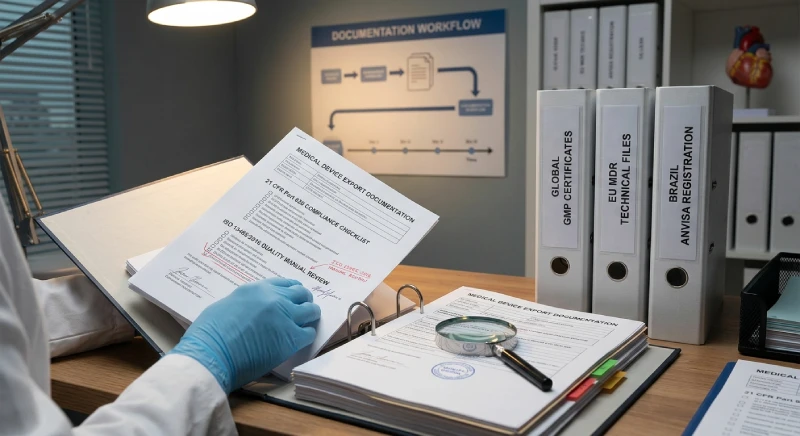
Medical devices face more demanding export documentation requirements than almost any other product category. A foreign regulatory authority reviewing a medical device import application does not just want to know that the device is legally sold in the United States. They want documentation that the facility where it was manufactured meets internationally recognized quality standards, that the manufacturing processes are validated and controlled, and that the device has cleared applicable US regulatory review. Good Manufacturing Practice certification is central to that documentation package.
This guide explains what GMP certification means specifically for medical device manufacturers, which markets require it, the different types of GMP certificates used in medical device export, and how Northern California device companies can obtain the documentation they need.
WHAT GMP MEANS FOR MEDICAL DEVICE MANUFACTURERS
For medical device manufacturers, Good Manufacturing Practice (GMP) requirements define the quality management framework that must govern design, production, testing, storage, and distribution. GMP is not a voluntary standard in this sector. It is a regulatory requirement, and noncompliance can result in FDA enforcement action, import refusal by foreign authorities, and, in markets where GMP certification is required for device registration, inability to sell, similarly to the food and pharmaceutical industries.
21 CFR Part 820: FDA Quality System Regulation
The FDA’s Quality System Regulation (QSR), codified at 21 CFR Part 820, is the US regulatory framework governing GMP for medical device manufacturers. It covers design controls, production and process controls, acceptance activities, corrective and preventive actions (CAPA), labeling and packaging controls, and document and record controls. The FDA inspects medical device manufacturing facilities under this framework, and a facility’s QSR compliance status is part of the record supporting an FDA Certificate to Foreign Government for medical devices.
In 2024, the FDA began aligning 21 CFR Part 820 more closely with ISO 13485:2016, the international medical device quality management standard, through the Quality Management System Regulation (QMSR) update. For device exporters, this harmonization is meaningful because it makes the FDA’s QSR requirements more directly comparable to what foreign regulatory authorities expect when they ask for GMP documentation.
ISO 13485: The International Medical Device Quality Standard
ISO 13485:2016 is the international standard specifying quality management system requirements for medical device manufacturers. Certification to ISO 13485 by an accredited third-party certification body is widely recognized by regulatory authorities in the European Union, Canada, Japan, Australia, Brazil, and many other markets as evidence of GMP compliance. In some markets, ISO 13485 certification from an accredited notified body or certification organization is the preferred or required form of GMP documentation for device registration.
How GMP and ISO 13485 Relate
The two frameworks address the same underlying purpose: ensuring that medical devices are consistently designed, manufactured, and controlled in a way that makes them safe and effective. FDA QSR (21 CFR Part 820) is a US regulatory requirement. ISO 13485 is an international voluntary standard that has been adopted by many national regulatory authorities as a prerequisite for market authorization. Device manufacturers targeting multiple international markets often pursue ISO 13485 certification precisely because it provides GMP documentation that is accepted across the broadest range of destination markets.
WHICH MARKETS REQUIRE GMP CERTIFICATION FOR MEDICAL DEVICE IMPORT
The list of markets that require formal GMP documentation for medical device import registration is long. The major ones that Northern California device exporters encounter most frequently are these.
- The European Union: Under the EU Medical Device Regulation (MDR 2017/745), medical devices placed on the EU market must meet requirements including Quality Management System compliance. EU-authorized representatives and notified bodies expect GMP documentation as part of the technical file and conformity assessment process. ISO 13485 certification from a recognized body is the standard approach for US device exporters entering the EU market.
- The Middle East (Saudi Arabia, UAE, and GCC countries): The Saudi Food and Drug Authority (SFDA) and equivalent bodies in GCC member states require GMP certificates and certificates of free sale as part of device registration applications. SFDA specifically requires both an FDA CFG for medical devices and a certificate of free sale from the device’s country of origin for most device categories.
- Southeast Asia (Indonesia, Thailand, Malaysia, Philippines): ASEAN medical device regulations increasingly require GMP documentation for device registration. Indonesia’s BPOM and Thailand’s FDA require GMP certificates from the manufacturer’s country as part of import registration for most Class II and Class III device categories.
- China: The National Medical Products Administration (NMPA) requires overseas medical device manufacturers exporting to China to obtain registration with NMPA, which includes submission of quality system documentation equivalent to GMP. The application process is demanding and typically requires ISO 13485 certification or an equivalent quality management system certificate.
- Brazil: ANVISA requires overseas medical device manufacturers to hold an Authorization for Operation of Companies (AFC) or equivalent GMP certification recognized by ANVISA before their products can be registered for sale in Brazil. The ANVISA process is one of the more documentation-intensive medical device registration pathways in Latin America.
TYPES OF GMP CERTIFICATES FOR MEDICAL DEVICE EXPORT
FDA Certificate to Foreign Government (CFG) for Medical Devices
The FDA issues Certificates to Foreign Government for medical devices under the Federal Food, Drug, and Cosmetic Act. The FDA medical device CFG certifies that the device is legally marketed in the United States, that the device is manufactured by a registered device establishment, and that the device is not subject to a pending enforcement action. Applications are submitted through the FDA Industry Systems portal and processed by the Center for Devices and Radiological Health (CDRH). Processing times vary but can take several weeks.
ISO 13485 Certification from Accredited Bodies
ISO 13485 certification is issued by third-party certification bodies accredited under ISO/IEC 17021-1. The certification process involves a documented quality management system, a Stage 1 documentation review, a Stage 2 on-site audit, and ongoing surveillance audits. For device exporters targeting EU, Canadian, Australian, Japanese, and many Asian markets, ISO 13485 certification from a recognized accreditation body (such as those operating under the International Accreditation Forum mutual recognition arrangement) provides the strongest cross-market GMP documentation.
Chamber-Issued GMP Certificates
For markets and product categories where an FDA CFG or full ISO 13485 certification is not the specified requirement, chamber-issued GMP certificates from recognized organizations such as WTC Northern California provide an official, recognized certification that the manufacturer operates under GMP standards. These are frequently required as supporting documentation in conjunction with the primary GMP certificate for certain market registrations, or as standalone documentation for lower-risk device categories in some markets.
HOW TO PREPARE FOR GMP CERTIFICATION AS A MEDICAL DEVICE EXPORTER
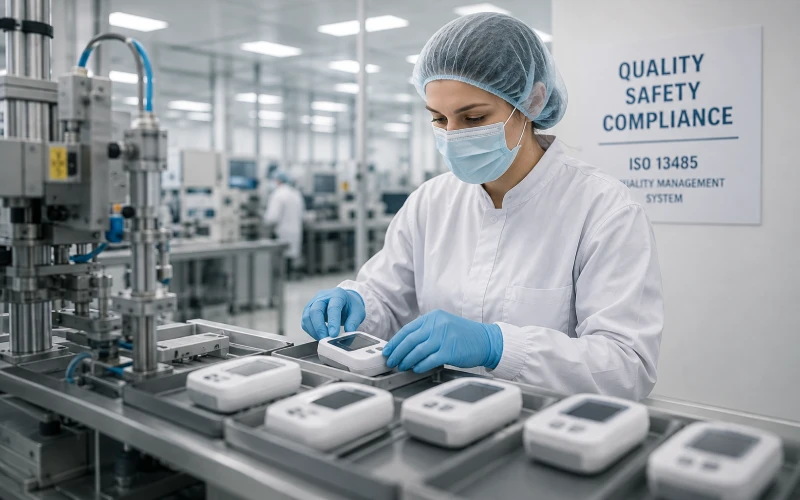
Preparation is the stage where most medical device exporters either invest appropriately or create problems that surface during the certification audit. The minimum preparation for a GMP audit at any level involves documented quality management procedures that cover design controls, production controls, complaint handling, CAPA processes, and management review.
For FDA CFG applications, the facility must be registered with FDA as a device establishment and must be current on any applicable 510(k) clearances or PMA approvals. The registration status and clearance or approval history are what the CFG application draws on. For ISO 13485 certification, the quality management system documentation must be in place, and the system must have been operating for a sufficient period (typically three to six months minimum) before the certification audit.
Device exporters targeting multiple markets simultaneously are well-served by pursuing ISO 13485 certification first and then obtaining FDA CFGs and chamber-issued certificates as supplementary documentation for specific market requirements. The ISO 13485 framework is close enough to FDA QSR requirements that the documentation developed for one purpose supports the other with relatively modest additional effort.
COMMON DOCUMENTATION REQUIREMENTS ALONGSIDE GMP
GMP certification does not stand alone in most medical device export documentation packages. The full set of documents required varies by market and device classification, but these components appear consistently.
A certificate of free sale confirms that the device is legally marketed in the United States without restriction. The SFDA and most GCC markets require both a GMP certificate and a certificate of free sale for device registration. WTC Northern California issues certificates of free sale for medical device exporters through the Swiftdox digital platform.
A declaration of conformity or certificate of conformity is required for devices entering the EU under MDR, confirming that the device meets applicable essential requirements. This document is prepared by the manufacturer and, for Class II and Class III devices, reviewed and countersigned by the EU notified body.
A technical file or device master record is the compilation of design, manufacturing, testing, and clinical evaluation documentation that supports the device’s conformity assessment. While not a “certificate,” the technical file is what certifying and regulatory bodies review to issue the certificates described above.
HOW WTC NORTHERN CALIFORNIA SUPPORTS MEDICAL DEVICE EXPORTERS
WTC Northern California issues GMP certificates and certificates of free sale for medical device manufacturers in Northern California through the Swiftdox digital platform. Applications are submitted online, reviewed by the WTC NorCal trade team, and issued digitally within one business day for most applications. Digital certificates include electronic signature and blockchain verification, which is accepted by customs and regulatory authorities worldwide.
WTC NorCal trade specialists can also guide device exporters through the broader documentation requirements for specific market registrations: identifying which documents are needed, what sequence they should be obtained in, and where FDA CFG or ISO 13485 certification is required versus where a chamber-issued certificate is sufficient. For medical device companies in the Sacramento and Bay Area regions, WTC Northern California is the local trade documentation resource for the export-side of the market entry process. Contact the trade team at (916) 447-9827.
FREQUENTLY ASKED QUESTIONS ABOUT GMP CERTIFICATION FOR MEDICAL DEVICES
- What is GMP certification for medical devices? – GMP certification for medical devices is documentation confirming that a manufacturer’s facility, processes, and quality management system meet Good Manufacturing Practice standards under applicable regulations. In the United States, the relevant framework is 21 CFR Part 820 (FDA Quality System Regulation). Internationally, ISO 13485:2016 is the widely recognized quality management standard for medical device manufacturers. Both serve as evidence of GMP compliance for foreign regulatory authorities reviewing import registration applications.
- Which countries require GMP certification to import medical devices? – Most major import markets require GMP documentation as part of medical device registration, including the European Union (under MDR), Saudi Arabia and GCC countries, Indonesia, Thailand, Malaysia, China, and Brazil. The specific form of GMP documentation required varies by market: the EU typically accepts ISO 13485 certification, Saudi Arabia requires an FDA CFG plus certificate of free sale, and China requires NMPA registration supported by quality system documentation.
- What is the difference between ISO 13485 and FDA QSR for medical devices? – 21 CFR Part 820 (FDA QSR/QMSR) is the US regulatory requirement for medical device quality systems, enforced by the FDA through facility inspections. ISO 13485 is an international voluntary standard for medical device quality management systems that has been adopted by many national regulatory authorities as a condition for market access. For device exporters, ISO 13485 certification from an accredited body typically provides broader international market access than FDA QSR compliance alone, because it is recognized by the EU, Canada, Japan, Australia, and many other markets.
- How long does it take to get GMP certified for medical device export? – Timeline depends on the type of certification. An FDA Certificate to Foreign Government for medical devices is typically processed in several weeks through the FDA Industry Systems portal. ISO 13485 certification from an accredited body typically takes three to twelve months, including quality management system documentation development, a Stage 1 review, and a Stage 2 audit. Chamber-issued GMP certificates from WTC Northern California are processed within one business day through the Swiftdox platform.
- Does WTC Northern California issue GMP certificates for medical devices? – Yes. WTC Northern California issues GMP certificates for medical device exporters through the Swiftdox digital platform, with processing completed within one business day for most applications. Chamber-issued GMP certificates are accepted in many markets and are often required as supplementary documentation alongside FDA CFGs or ISO 13485 certificates for specific market registrations. Members pay reduced rates; contact WTC NorCal at (916) 447-9827 for current pricing.